
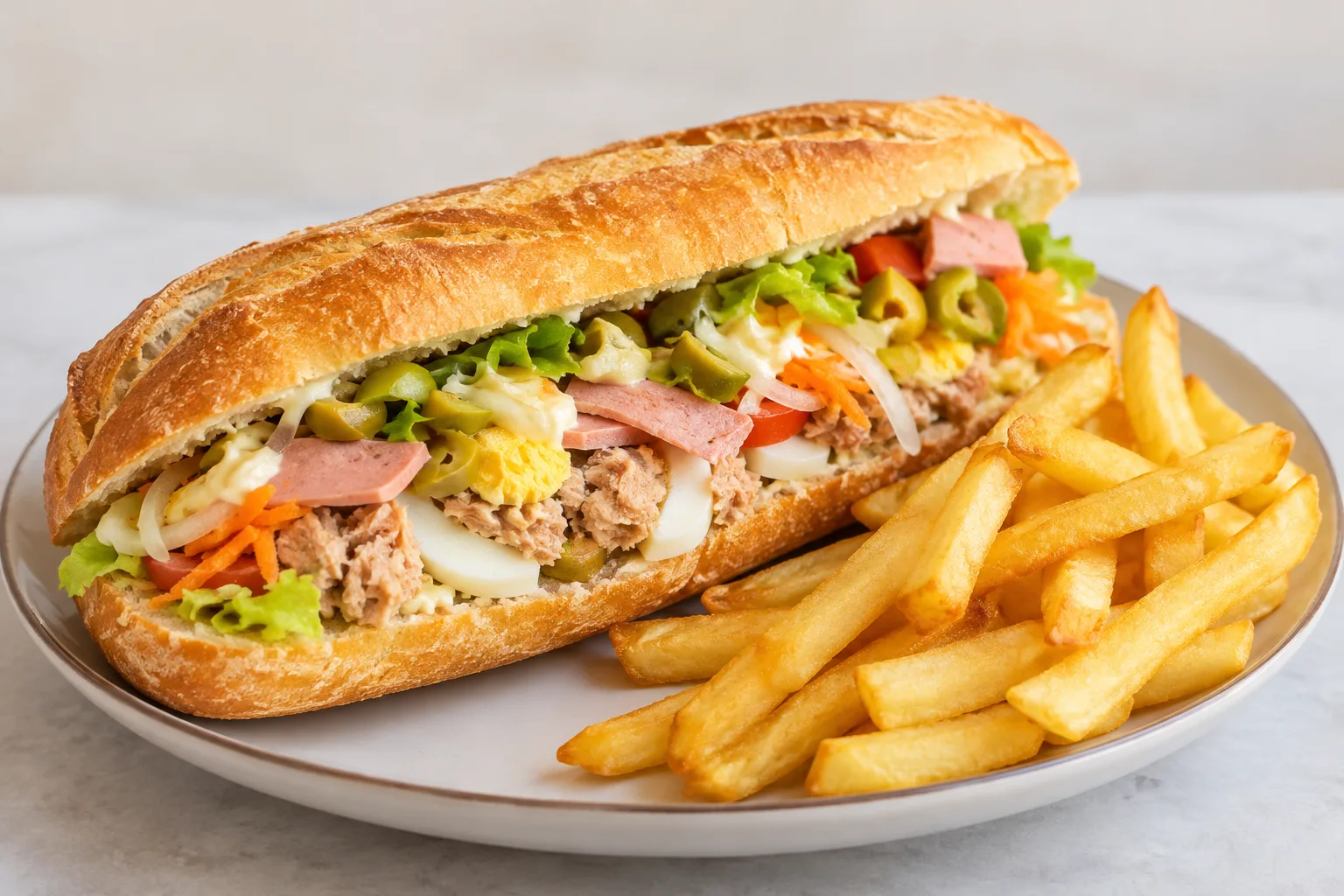
Street food in Morocco changes from one city to the next. In Tangier, I order a loaded bocadillo called Tangawi. In Salé, I look for hot maakouda. Oujda brings karan with a cold lemon drink, while in Rissani, I order medfouna ahead of time and return when the stuffed bread is ready to eat warm.
This guide follows four Moroccan street food meals I have eaten myself. I’ll show you what goes inside them, where I ordered them, how locals order them, what I paid during my visits, and a few details worth knowing before you reach the counter.
Tangier: Order a Tangawi Bocadillo
In Tangier, one of my stops is Snack Brahim Abdelmalik on Rue du Mexique, near Sour El Maâgazine. The counter offers several bocadillo fillings, including chicken, kefta, sausage, shawarma, and omelette with cheese. But when I want the version I associate most with Tangier, I order the Tangawi.
The sandwich starts with a French-style baguette. Locally, I use the word kumira for one baguette and komir for the plural. Inside goes tuna with kachir, also called lanchoun, followed by tomato, lettuce, grated carrot, thinly sliced onion, boiled eggs, rice, and mashed potato.
Chopped olives add another layer of flavour. The homemade mayonnaise includes finely chopped onion and pickles. Once everything is packed inside, the sandwich becomes a full meal rather than a light snack. Mine was served wrapped in paper with French fries on the side.
When ordering, ask for a Tangawi. If you want tuna without kachir, order the thon bocadillo instead. Sauces such as Algérienne, Biggy, and Samurai are also available, so ask about the flavour and heat before adding one.
My Tangawi with fries cost US$2.08 in March 2026. For a first visit, I would order the Tangawi by name and mention any changes to the filling before the sandwich is prepared.
Salé: Try Maakouda in a Sandwich or on Its Own
In Salé, maakouda is one of the street foods I return to. I have two favourite stops. One is Sghiyer’s small shop near Souk El Kbir in the old medina. The other is Snack Nabil on Avenue Oujda in Sidi Moussa, near Pharmacie Avenue Oujda.
At these shops, the first choice is not simply how many maakouda you want. You also decide how you want to eat them.
During my August 2026 visit to Snack Nabil, I ordered half a loaf with two maakouda pieces inside. The hot fried potato patties were combined with the shop’s mixed salad, turning the sandwich into a filling lunch.
The salad mixture includes rice, pasta, potatoes, boiled eggs, tuna, kachir, corn, lettuce, tomato, onion, and boiled beetroot mixed with mayonnaise. Ketchup and hot sauce are available if you want them. You can also choose a smaller bread instead of the half loaf.
There is another way I like to order maakouda. Ask for معقودة حرفية. At these shops, I use this phrase for maakouda served without bread. The seller splits the fried potato patty and fills the centre with kachir and mayonnaise.
You can order one piece or several depending on your appetite. At Snack Nabil, one filled maakouda cost US$0.10 during my visit. It is an easy way to taste the maakouda without ordering a full sandwich.
The mixed salad is also sold separately, but maakouda is not automatically included. If you want both, order both. Soft drinks are separate as well.
Oujda: Order Karan with Barida
In Oujda, my order is karan with barida. The karan starts in a large baking tray. The seller cuts a portion, places the soft chickpea-and-egg mixture inside bread, then finishes it with paprika and cumin.
Beside it, I order barida, the cold lemon drink I associate with this meal.
The karan preparation I know combines ground chickpeas with eggs, garlic, salt, cumin, saffron, and vegetable oil before baking. Once a portion is placed inside bread and topped with spices, it becomes a simple street meal you can eat straight after ordering.
I ate mine at the small traditional oven I know as Abderahman’s in Lazaret in June 2026. The karan sandwich and barida together cost US$1.04-1.25.
If you want the same combination, ask for both karan and barida and confirm the total price. Do not assume the drink is automatically included with every sandwich.
Rissani: Order Medfouna Before You Arrive
Rissani changes the rhythm completely. Medfouna is not something I order when I am already hungry and expect to eat five minutes later.
In September 2025, I ordered mine from a small traditional oven known to me as Abdeladim, near the old medina. The baker needed about one hour to prepare and cook it, so we placed the order before we wanted to eat.
The medfouna arrived warm and ready to share with tea. Inside the thick dough were beef, beef fat, and onion, seasoned with garlic, coriander, parsley, and ras el hanout. Almonds completed the filling.
You will also see medfouna written as madfouna. The Rissani version I ate was larger and more strongly flavoured than the thinner-dough version I know from Errachidia. Bakers have their own versions, so ask about the filling and size when placing your order.
The large medfouna from my visit served roughly seven to ten people. The whole order, including tea, cost around US$7.27-13.51 at the time.
For a group, agree on the size and total price before preparation begins. More importantly, arrange a collection time. Give the baker time to prepare it, then return while the bread is still warm.
Medfouna is a meal made for sharing, and I prefer eating it slowly with Moroccan tea rather than treating it like a quick takeaway.
More Moroccan Street Food in Marrakech and Fez
These four cities show only part of Morocco’s street food culture. Marrakech has its own foods, routines, and hours.
Some of my strongest food memories there include early-morning bawlo near the slaughterhouse and tanjia eaten with friends. I cover those foods and the way I know them in my Marrakech street food guide.
Fez offers a different experience. My food walk through the Fez medina starts around Bab Boujloud and continues through soup, maakouda, and other stops inside the medina.
If your trip includes Marrakech or Fez, use those guides alongside this one rather than trying to treat Moroccan street food as one national menu. What I look for changes with the city.
Moroccan Street Food Prices from My Visits
These are the prices I paid or recorded during my visits. I converted them to approximate US dollars. Prices and portion sizes change, so check the current price before ordering, especially when buying a large medfouna for several people.
| Place and visit | Order | Price |
|---|---|---|
| Tangier, March 2026 | Tangawi bocadillo with French fries | US$2.08 |
| Snack Nabil, Salé, August 2026 | Maakouda sandwich | US$0.52-0.73 |
| Snack Nabil, Salé, August 2026 | One maakouda with kachir and mayonnaise, without bread | US$0.10 |
| Snack Nabil, Salé, August 2026 | Mixed salad, maakouda ordered separately | US$1.04 |
| Oujda, June 2026 | Karan sandwich with barida | US$1.04-1.25 |
| Rissani, September 2025 | Large whole medfouna with tea, roughly 7-10 servings | US$7.27-13.51 |
The ordering details matter as much as the food. In Tangier, ask for the Tangawi by name. In Salé, decide whether you want maakouda inside bread or served as individual filled pieces. In Oujda, ask for barida with your karan. In Rissani, order the medfouna early and agree on when to collect it.
If you are travelling through Morocco, start with the food associated with the city you are visiting. That is usually where the most interesting street food experience begins.

CONVERSATION