
To understand the connection between Moroccan food and the Mediterranean diet, it helps to begin in the kitchen rather than with a list of foods described as healthy. Consider a fish tagine coming slowly to a simmer: garlic and coriander worked into a chermoula marinade, tomatoes softening beneath the fish, and olive oil carrying the spices through the sauce. Beside it, a small dish of taktouka brings the sweetness of roasted peppers together with tomatoes and cumin. Nothing in this meal has been redesigned to fit a fashionable way of eating. These are familiar Moroccan preparations, built from ingredients that also appear in the wider Mediterranean food tradition.
Is Moroccan food Mediterranean? Geographically, yes: Morocco has a Mediterranean coast, and its cooking shares olive oil, vegetables, legumes, grains, herbs and fish with cuisines around the sea. But Moroccan food is not simply another version of Greek, Italian or Spanish cooking. It has its own techniques, regional identities and history, shaped by Amazigh, Arab, Andalusian, Atlantic and Saharan influences. The useful comparison is not whether every Moroccan dish fits a modern dietary label, but how traditional meals can embody some of the habits associated with Mediterranean-style eating.
What Moroccan cooking shares with Mediterranean-style eating
The Mediterranean diet is not one fixed menu. It is a broad eating pattern that places importance on vegetables, fruit, pulses, whole grains and unsaturated fats such as olive oil, while leaving room for fish and other foods in differing amounts. Moroccan cooking offers many natural examples. Lentils and white beans are simmered with tomatoes, garlic and spices; seasonal vegetables are cooked into tagines or served as salads; fish is seasoned with fresh herbs and lemon. The interest lies in the complete meal and the way it is prepared, not in declaring one spice or ingredient a miracle food.
For example, cumin belongs in many Moroccan legume dishes because its earthy flavor suits beans and lentils. Coriander and parsley give chermoula its fresh, green character, while preserved lemon contributes both fragrance and saltiness. Olive oil is more than a garnish: it helps soften aromatics, develop the sauce and bring flavors together. These are practical decisions a cook makes at the stove. They matter far more to the final dish than scattering extra spices over the top just before serving.
There are differences, too. Moroccan food also includes richly prepared meat dishes, fried specialties, butter, smen, sweet pastries and festive meals. They remain part of its culinary identity. Nor is traditional couscous simply a quick grain salad: it is steamed, loosened and served according to a method developed around the couscoussier. Our traditional Moroccan couscous guide explains that method in more detail. A Mediterranean-style eating pattern may influence someone's choices across the week, but it should not be used to rewrite the history of individual Moroccan dishes.
Two preparations illustrate the overlap particularly well. Fish tagine with chermoula depends on a patient vegetable base and careful timing for the fish. Taktouka turns peppers and tomatoes into a concentrated cooked salad without losing their individual character. Served together, they offer a convincing Moroccan meal rather than a dish invented to satisfy a nutrition trend.
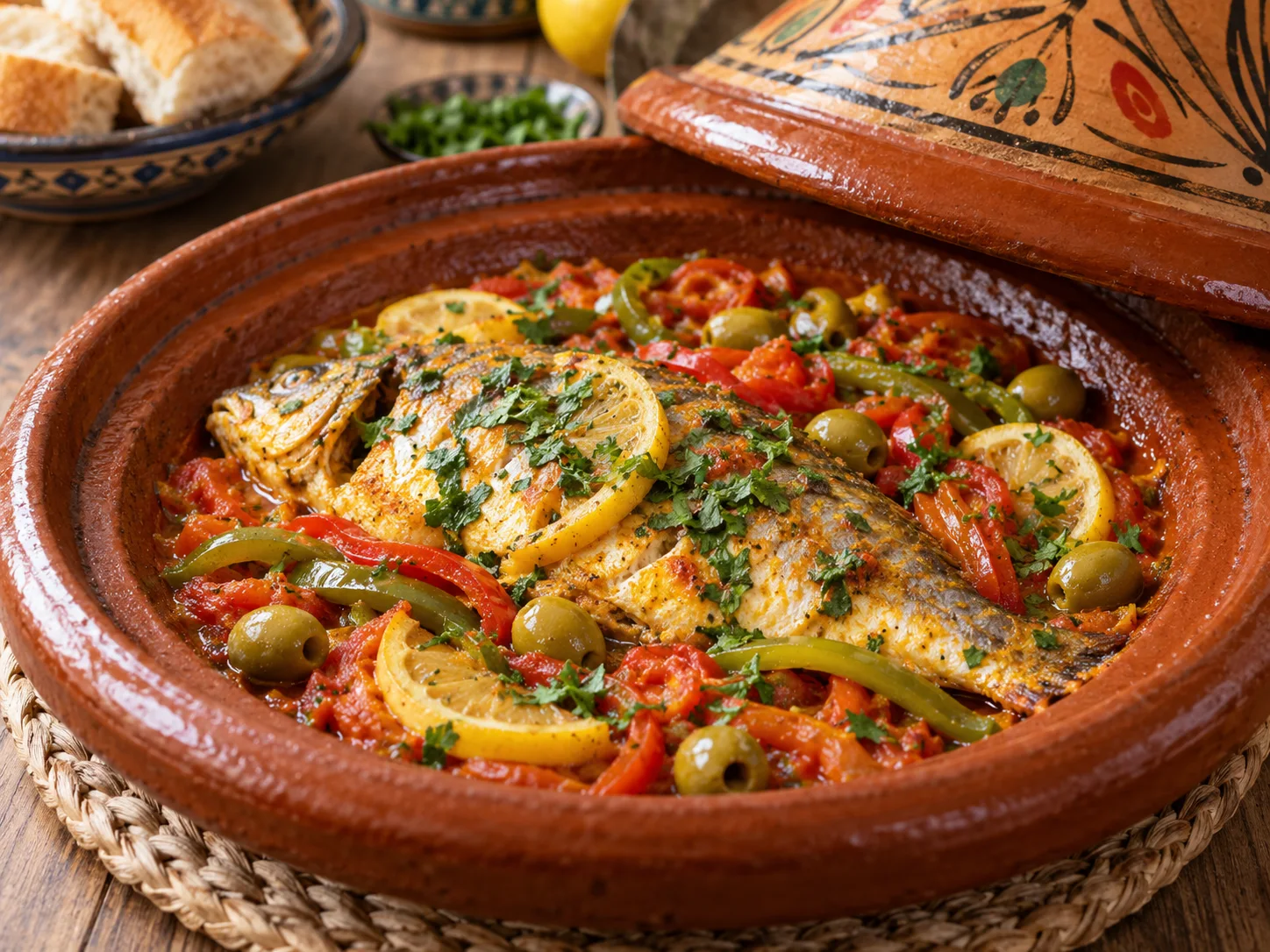
Moroccan Fish Tagine with Chermoula
On Morocco's Atlantic and Mediterranean coasts, fish is often cooked with the ingredients that give chermoula its unmistakable fragrance: garlic, coriander, parsley, cumin, paprika and lemon. There are many household versions of fish tagine, and the vegetables vary with the season and the fish available. The approach here uses a familiar combination of potatoes, carrots, tomatoes, pepper, olives and preserved lemon. The important point is to let the vegetables get ahead of the fish. Potatoes need time to become tender; fish usually does not.
The marinade should smell of fresh herbs and garlic before it goes anywhere near the tagine. Chop the herbs finely enough to coat the fish, but do not turn them into a watery purée. A little lemon juice brightens the mixture, while the preserved lemon added during cooking supplies a deeper, more rounded citrus flavor. Salt cautiously because preserved lemon and olives already contribute some.
Ingredients for four servings
- 800 g firm white fish, cleaned and cut into large steaks or portions, such as sea bream or hake
- 2 medium potatoes, peeled and sliced thinly
- 1 medium carrot, cut into thin rounds
- 2 ripe tomatoes, grated
- 1 green pepper, sliced into rings
- 3 garlic cloves, crushed
- 1/2 cup finely chopped fresh coriander (cilantro)
- 1/2 cup finely chopped fresh parsley
- 3 tablespoons olive oil
- 1 tablespoon fresh lemon juice
- 1 teaspoon ground cumin
- 1 teaspoon sweet paprika
- 1/2 teaspoon ground turmeric, optional
- Black pepper and salt to taste
- 1/2 preserved lemon, cut into strips
- A small handful of green olives
- About 100 to 150 ml water, added as needed
How to prepare the fish tagine
1. Make the chermoula and marinate the fish
Mix the crushed garlic, coriander, parsley, olive oil, lemon juice, cumin, paprika, optional turmeric and a little black pepper. Set aside roughly one-third of this chermoula for the vegetables before the mixture touches the raw fish. Coat the fish with the remaining marinade, cover and refrigerate for about 20 minutes while you prepare the base. This short rest is enough to season the surface; a long acidic marinade is unnecessary, especially for delicate fish.
2. Begin cooking the vegetable base
Arrange the potato slices and carrot rounds in a wide tagine or heavy, covered pan. Spoon over the grated tomatoes, the chermoula you reserved for the vegetables and a little water. Cover and cook gently until the vegetables begin to soften, about 15 to 20 minutes depending on their thickness and the heat. Check the base rather than relying only on the clock: the potatoes should no longer feel completely hard when pierced, but they need not be fully cooked yet. Add a splash more water if the tomato sauce starts to catch.
3. Add and gently cook the fish
Set the marinated fish over the vegetables and arrange the pepper rings, preserved-lemon strips and olives around it. Cover again and keep the heat low enough for a gentle simmer, not a vigorous boil. Allow approximately 12 to 20 minutes for the fish to cook through, depending on the size and thickness of the pieces; check that it is opaque and separates easily with a fork, or reaches 63°C (145°F) at its thickest point. By this stage the potatoes should be tender and the sauce lightly reduced. If the vegetables need more time, remove the cooked fish carefully and let the base finish rather than drying out the fish.
4. Serve the fish tagine
Bring the tagine to the table with its sauce still around the vegetables. Moroccan bread is well suited to gathering up the chermoula and tomato juices. The fish should remain in generous pieces, not broken into a stew. For more about Morocco's coastal cooking and the role of fresh seafood, see our Moroccan seafood guide.
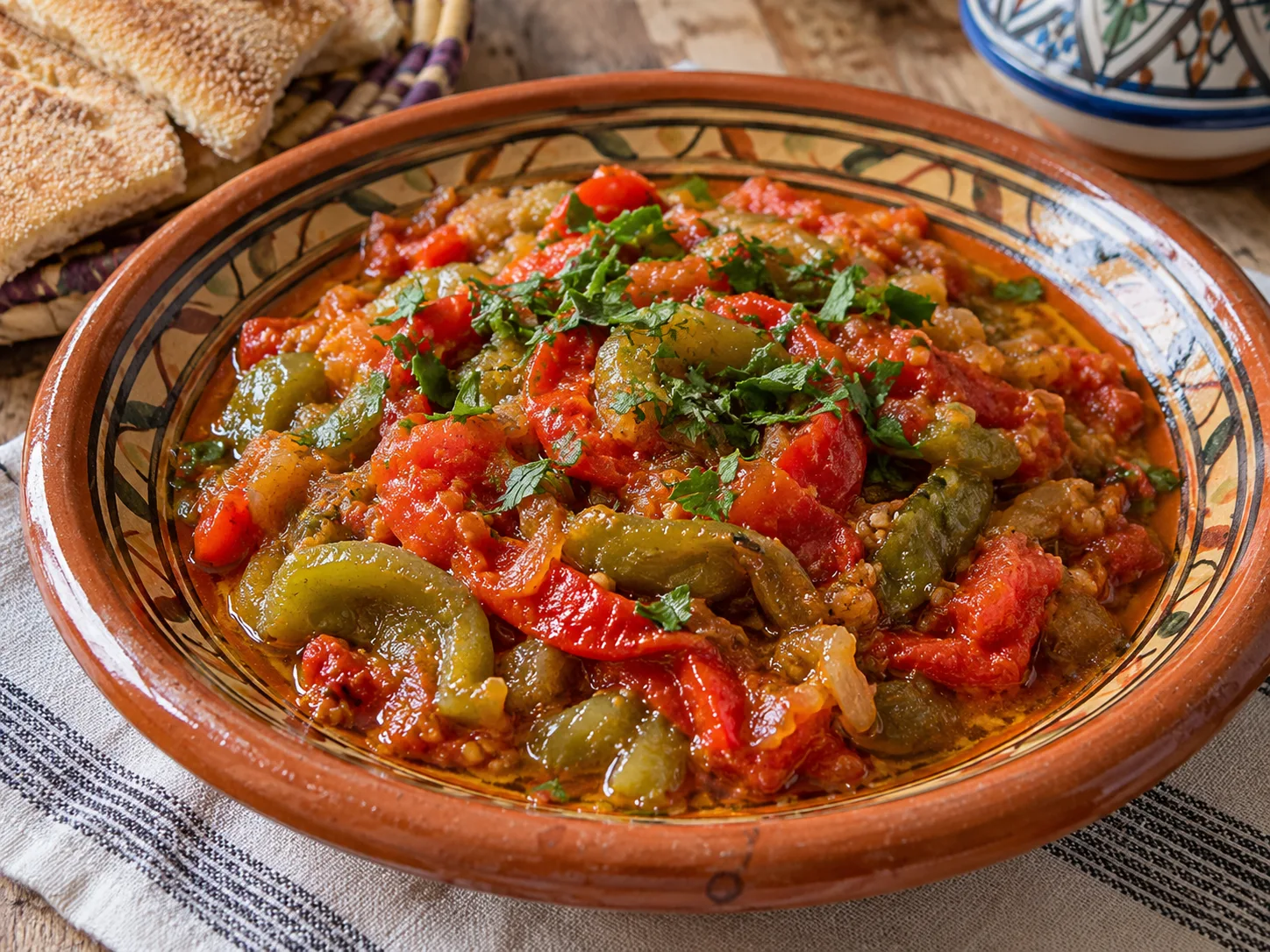
Traditional Moroccan Taktouka
Where the fish tagine asks for gentle heat, taktouka rewards patience with reduction. This traditional Moroccan cooked salad begins by roasting peppers until their skins blister. Peeling them removes the tough charred skin while keeping the soft flesh and a little smoky aroma. The peppers are then chopped and cooked with tomatoes, garlic, olive oil and spices until the mixture becomes thick enough to hold together on bread. A bowl of raw diced peppers and tomatoes may taste pleasant, but it is not the same preparation.
Ingredients for four small side portions
- 3 large green or mixed green and red bell peppers
- 4 medium ripe tomatoes, peeled and finely chopped or grated
- 2 garlic cloves, finely chopped or crushed
- 2 tablespoons olive oil
- 1 teaspoon sweet paprika
- 1/2 teaspoon ground cumin
- Salt and black pepper to taste
- 1 to 2 tablespoons chopped parsley or coriander, optional
How to prepare taktouka
1. Roast, peel and chop the peppers
Roast the peppers over a flame, under a hot grill or in a very hot oven, turning them until the skins blister on all sides. Place them in a covered bowl for about 10 minutes; the trapped steam makes them easier to peel. Remove the skins, stems and seeds, then cut the flesh into small pieces. Resist the temptation to rinse the peppers heavily under running water, which can wash away some of their roasted flavor.
2. Cook the tomato sauce and peppers
Warm the olive oil in a wide pan over medium-low heat, then add the garlic and tomatoes with the paprika, cumin and a little salt. Let the tomatoes cook down for roughly 12 to 15 minutes, stirring occasionally, until much of their liquid evaporates. Add the chopped roasted peppers and continue cooking gently for another 10 to 15 minutes. Stir often toward the end. The finished taktouka should be soft and glossy, with a concentrated tomato-and-pepper flavor rather than a pool of watery sauce. Taste again before serving, adding the optional herbs at the end if you like.
3. Serve the taktouka
Taktouka can be served warm or at room temperature. A small dish beside fish, with bread for sharing, is enough; it does not need to be turned into a main course to justify its place at the table. It also belongs to a much wider family of Moroccan cooked salads, alongside zaalouk and carrot preparations, each with a distinct method. Our guide to traditional Moroccan salads
What these dishes tell us about eating well
A fish tagine and a dish of taktouka make the Moroccan connection to Mediterranean-style eating easy to see. They bring vegetables, fish, olive oil and fresh herbs into an ordinary meal, but they remain Moroccan because of their preparation, seasoning and way of serving. One depends on layering ingredients and controlling a covered simmer; the other depends on roasting and reducing until the vegetables develop their full flavor. Neither technique is improved by replacing it with a generic “Mediterranean twist.”
Of course, enjoying these meals does not mean every Moroccan dish needs to be low in fat, meat-free or measured against a rigid nutritional rule. The broader Mediterranean-style pattern is about the balance of foods over time. The American Heart Association's overview of Mediterranean-style eating discusses that pattern without requiring every culture to prepare its food in the same way. For a separate look at what Moroccan families eat beyond this particular comparison, visit The Moroccan Diet: What Moroccans Really Eat.
Moroccan cooking does not need to borrow an identity from another region to make sense of its ingredients. Fish seasoned with chermoula, peppers roasted for taktouka, lentils simmered slowly and vegetables prepared with care already tell their own story. Their connection to Mediterranean-style eating is real, but so is the distinct tradition behind the food. The best way to appreciate both is to cook the dishes properly and let that experience speak for itself.

CONVERSATION