
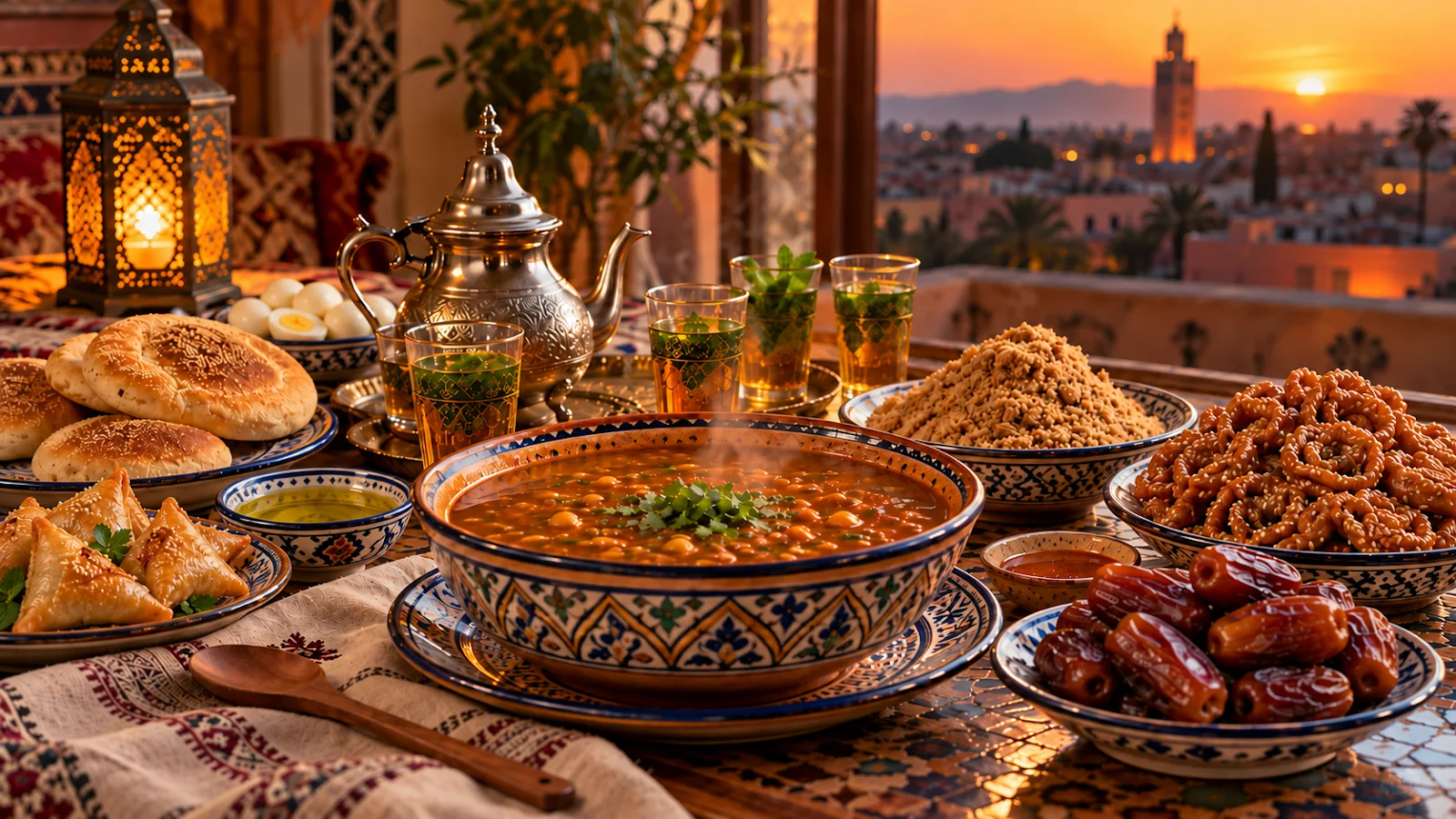
A Moroccan Iftar is easier to understand when you stop thinking of it as a menu of five or ten fixed dishes. In Moroccan homes, the table changes from one family to another, but a few foods are so closely associated with Ramadan that seeing them together immediately feels familiar.
The strongest example is the combination of dates, harira and chebakia. In the Moroccan homes I know, these are not three unrelated foods placed on the same table for variety. They belong naturally to the rhythm of Iftar. Dates are there when the fast ends, harira brings the warm savory part of the meal, and chebakia provides the sweet contrast that Moroccans strongly associate with Ramadan.
Around them, families add their own foods according to habit, region, season and what has been prepared that day. Some tables are large, especially when guests are present. Others are simple. What makes the meal Moroccan is not the number of plates but the way familiar Ramadan foods come together around a shared table.
How Iftar Begins in a Moroccan Home
During Ramadan, the daily food rhythm changes completely. Family members who have been fasting wait until sunset, and the Iftar table is usually prepared before the fast ends so that everyone can sit down together when the time comes.
Dates are commonly present at this first moment. They do not need to be filled with almond paste, coated in nuts or turned into a separate dessert recipe. Plain dates already belong naturally on the Ramadan table.
Once the meal begins, people do not necessarily move through the food like a formal restaurant service with one course removed before another arrives. Several items can already be on the table, and people eat according to the foods in front of them and the habits of the household.
This shared style fits the broader Moroccan way of eating described in our guide to Moroccan dining etiquette . During Ramadan, however, the timing gives the meal a different atmosphere because the family has been waiting for sunset together.
Harira Is at the Heart of Moroccan Iftar
Of all the foods associated with Moroccan Ramadan food, harira is one of the most recognizable. It is a rich soup built around ingredients such as tomato, legumes, herbs and spices, although recipes differ considerably between households.
What matters here is its place at Iftar. Harira is not a dish invented only for Ramadan; Moroccans eat it at other times as well. But during Ramadan its presence becomes much more regular, and for many families it is one of the foods that makes the table immediately feel like Iftar.
The soup is usually served hot. Beside it you will often find dates and chebakia, giving the table its familiar savory-and-sweet balance. Lemon may also be available for people who like to add some acidity to their bowl.
A useful mistake to avoid when talking about Moroccan food is to describe every family as making exactly the same harira. Some recipes are thicker, others lighter. Ingredient proportions and preparation can change from one home or region to another. The Ramadan connection is stronger and more consistent than any single universal recipe.
Chebakia and the Taste of Ramadan
If harira brings the savory side of Moroccan Iftar, chebakia is one of the sweets most strongly tied to the same table. Its twisted shape, fried dough, sesame and fragrant syrup make it very different from an everyday biscuit.
In my family method, chebakia begins with flour combined with ingredients such as toasted sesame, cinnamon, aniseed, saffron, orange blossom water, oil and browned butter. The dough is rolled thin, cut and folded into the familiar woven shape before frying.
After frying, the pieces are coated in a homemade syrup prepared with sugar, water, cinnamon, orange blossom water and cloves. That detail is worth keeping because Moroccan households do not all prepare chebakia in exactly the same way, and the version I know does not depend on bee honey.
Chebakia makes particular sense beside harira. One is warm, savory and spooned from a bowl; the other is sweet, fried and fragrant. Add dates and you have the trio that, for many Moroccans, immediately evokes Ramadan.
For the detailed pastry method and the differences between Moroccan sweets, see our guide to Moroccan cookies and Chebakia .
Where Sellou Fits Into Ramadan
Sellou, also called sfouf in some contexts, is another food closely associated with Moroccan celebrations and Ramadan. It is very different from harira and chebakia because it is made as a dense dry mixture rather than a soup or fried pastry.
Typical versions combine roasted flour with sesame and almonds, along with aromatic ingredients such as cinnamon and anise. Butter and a sweetener bring the mixture together, although exact proportions and preparation vary considerably from one family to another.
Sellou can be prepared ahead of time and kept ready during Ramadan, which is part of what makes it practical in the home. It is usually served in smaller portions rather than treated like the main meal.
I would not describe Sellou as something every Moroccan must eat at every Iftar. It is better understood as one of the characteristic Ramadan foods that may appear alongside the stronger core of harira, dates and chebakia.
Not Every Moroccan Ramadan Food Belongs to Every Iftar
This is where many lists of “traditional Moroccan Iftar dishes” become misleading. They collect anything Moroccan into one article and make it sound as though all of it appears every evening during Ramadan.
Bissara is a good example. It is a genuine Moroccan dish made from dried legumes and is especially comforting in colder weather. It can certainly appear in Moroccan homes, but I would not use it to define the national Iftar table in the same way as harira.
The same applies to elaborate stuffed dates. Almond-filled dates can be prepared as a sweet, but ordinary dates are the more important food when explaining how Moroccans traditionally break the fast. Making them complicated actually hides the simpler cultural role they already have.
Other breads, pastries, savory dishes and drinks depend more heavily on the household. Ramadan lasts an entire month, so families naturally change what they prepare instead of reproducing the same large menu every evening.
Tea, Sweets and the Rest of the Evening
Moroccan mint tea can also be part of Ramadan evenings, but there is no single rule that says tea must appear at one exact point during Iftar. In some homes it comes with sweets; in others it is served later, after people have had time to eat and relax.
This flexibility is normal in Moroccan hospitality. Tea is part of social life beyond Ramadan as well, so its presence should not be presented as a rigid Iftar course.
If you want to prepare it in the traditional style, see our guide to Moroccan mint tea .
What a Moroccan Iftar Really Represents
The most useful way to understand Moroccan Iftar is not to memorize a list of dishes. Think instead about the foods that return throughout Ramadan and the way people share them.
Dates mark the end of the fast. Harira brings warmth and familiarity to the table. Chebakia gives the meal its unmistakable Ramadan sweetness. Sellou and other foods may join them depending on the household, while additional dishes change from one evening to the next.
That variation is part of the tradition rather than an exception to it. A Moroccan family does not need an overloaded table to have an authentic Iftar. A simple meal shared at sunset can carry the same meaning as a large gathering prepared for relatives and guests.
For visitors, this is also an important distinction. Ramadan in Morocco changes the timing of everyday life, but Moroccan Iftar is still a family meal before it becomes a tourist experience. Understanding the foods in that context tells you much more about Moroccan Ramadan culture than simply collecting a long list of recipes.

CONVERSATION