
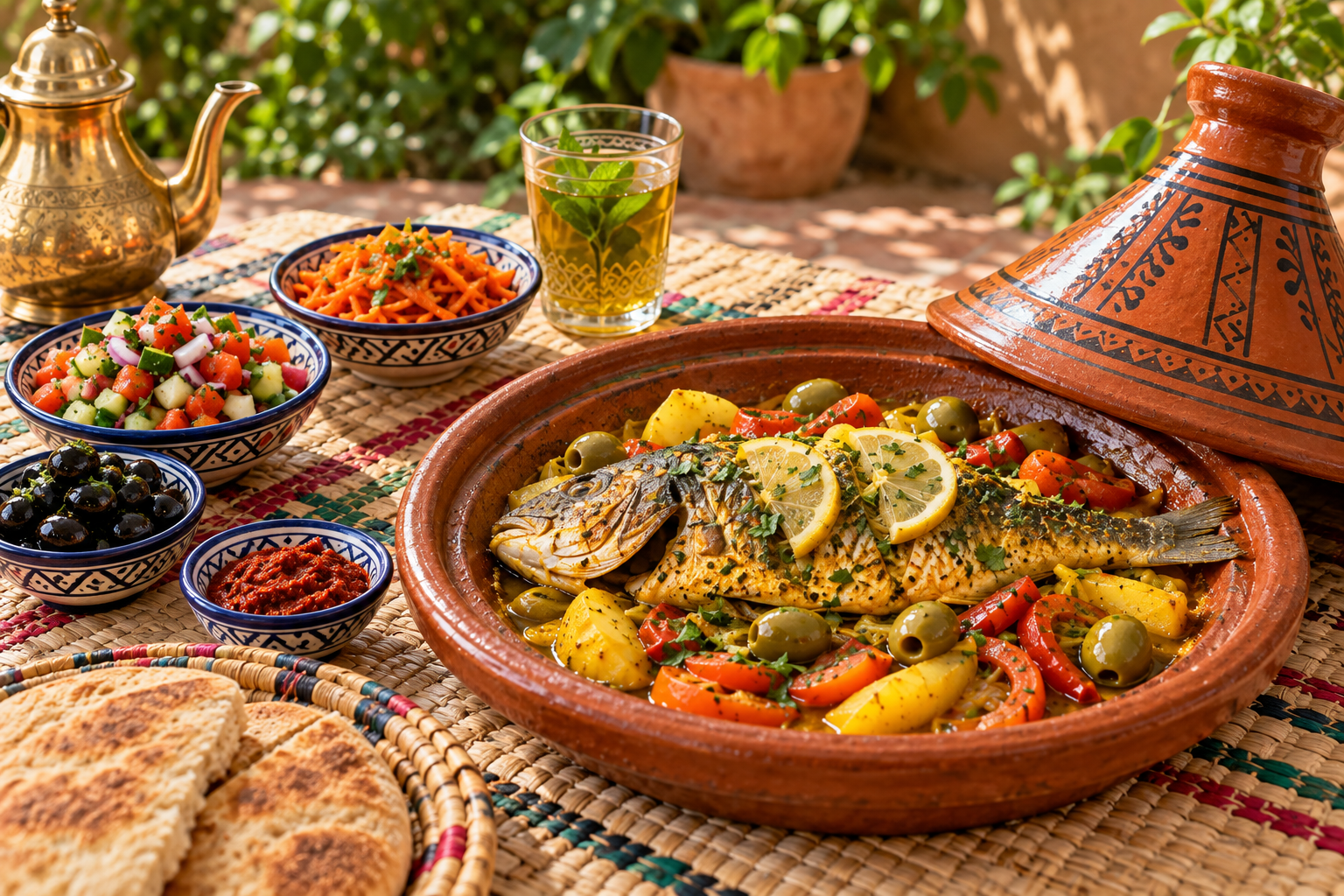
The Moroccan diet is difficult to describe with one plate because Moroccan families do not eat the same way every day. A weekday meal at home can be very simple, while Friday, Ramadan, a family gathering or a meal prepared for guests can look completely different. What connects them is not a strict diet plan, but a way of eating built around bread, vegetables, shared dishes, olive oil, olives, legumes, meat, fish, fruit and tea.
Growing up in Morocco, I never thought of our food as a “Moroccan diet.” It was simply what we ate. Bread was on the table, salads might surround the main dish, tea could appear more than once during the day, and the main meal changed according to the family, the season and what was available. Some days were built around vegetables, while others included chicken, beef, lamb or fish.
That is a more useful way to understand Moroccan food than reducing it to tagine and couscous. Those dishes are important, but the everyday table is much broader.
Moroccan Eating Starts With Bread and the Shared Table
Bread is one of the most constant parts of Moroccan eating. Round Moroccan khobz is not simply an extra item placed beside the meal. It is often used to take vegetables, sauce and pieces of food directly from a shared dish, so it becomes part of the way the meal is eaten.
A table may also have olives, a fresh salad, cooked vegetables or another small dish beside the main food. In my experience, these are not normally treated as a formal appetizer course that disappears before the main dish arrives. They remain on the table and are eaten throughout the meal.
Tomato and onion cut into small pieces with salt and white vinegar is one simple example. Tomato with green pepper or tomato with cucumber can appear in the same way. Cooked preparations such as zaalouk, taktouka, potatoes, carrots, beets, roasted peppers or courgettes may each be placed in their own small plate.
That arrangement is important because it explains why a Moroccan meal can feel varied even when the main dish itself is simple. The table is built from several things eaten together rather than from a strict sequence of courses.
For more detail, see my guide to Moroccan salads and side dishes .
Breakfast Can Be Very Different From the Hotel Version
Visitors often meet Moroccan breakfast through hotels and riads, where a table may be filled with msemen, harcha, baghrir, bread, honey, jam, olives, eggs, tea and coffee. That is a beautiful presentation, but it should not be confused with the way every Moroccan family eats every morning.
In the older breakfast rhythm I know, there could be two morning eating moments. The first came early, after Sobḥ or Fajr, and could be very simple, with dates and hssoua. In colder weather, b'ssara could also appear because it is warm, filling and suited to the season.
A later breakfast, around mid-morning, might be built around round khobz with olive oil, honey, olives, butter or jben, accompanied by tea, milk or coffee. Msemen, harcha and baghrir are also familiar, but they do not need to appear together every day.
Breakfast also changes by region and household. In the Souss and Tafraout area, Amlou has its own place, while in other homes different breads, spreads or cooked foods may be more familiar.
I explain this difference in more detail in Moroccan Breakfast: What Moroccans Really Eat in the Morning .
Tagine Is Everyday Food, but It Is Not One Recipe
Tagine is one of the most recognizable Moroccan foods, but speaking about “tagine” as if it were a single recipe misses the point. The word can describe the cooking vessel and many different dishes prepared in it. One tagine may be based on vegetables, another on chicken, another on meat, and the vegetables and seasoning change with the preparation.
A vegetable tagine can be a complete meal in its own right. Potatoes, carrots, courgettes, tomatoes, onions and other vegetables can be arranged and cooked slowly until the sauce and vegetables come together. It is then eaten with bread directly from the shared dish.
One detail worth correcting is the common idea that a Moroccan tagine should automatically be served over couscous. That is not how I know these dishes at home. Couscous is its own preparation and its own complete meal. Tagine is normally eaten with bread rather than treated as a topping for couscous.
This distinction matters because Moroccan food makes more sense when each dish is understood in the way it is actually served rather than rearranged into a different meal structure for convenience.
Couscous Has Its Own Place on the Moroccan Table
Couscous is another central part of Moroccan cooking, but it is much more than grains with vegetables placed on top. Preparing it traditionally takes time. The couscous is steamed, separated and worked carefully while the meat, vegetables, chickpeas and broth cook below.
In the method I know, the meat is browned with spices before grated onion, tomato and garlic are added. Vegetables and soaked chickpeas cook in the broth, while faster vegetables such as courgettes, cabbage and pumpkin are added later so they do not disappear during cooking.
The couscous itself is steamed more than once rather than simply boiled. That is what gives it the light texture that makes traditional couscous different from instant preparation.
This is also why I do not treat couscous as a side dish for tagine. It has enough preparation, broth, vegetables and structure to stand as the meal itself.
You can see the full method in my guide to traditional Moroccan couscous .
Meat Is Important, but Moroccan Food Is Not Only Meat
Moroccan cuisine certainly includes plenty of meat. Chicken, beef and lamb appear in tagines, couscous, grilled dishes, festive meals and preparations made for guests. Some dishes, such as mechoui, are closely connected with larger gatherings and special occasions rather than being something every family prepares every day.
At the same time, a Moroccan table can contain many foods that are naturally meat-free. Bread, olives, lentils, beans, vegetable tagines, zaalouk, taktouka and fresh salads all belong to normal Moroccan cooking without being designed as modern meat substitutes.
That is why the Moroccan diet cannot be understood simply as meat-heavy or vegetarian. It moves between both depending on the household and the meal.
If you are specifically interested in the meat-free side of the cuisine, see Moroccan Vegetarian Dishes: Tagines, Salads and Everyday Food .
Fish Changes the Moroccan Diet Along the Coast
Fish and seafood are another important part of Moroccan eating, especially in coastal cities and towns. The Atlantic and Mediterranean coasts naturally influence what reaches the table, so a family meal in a coastal area may look different from one farther inland.
Chermoula is one of the preparations that makes sense in this context. Herbs, garlic, lemon and spices can be used with fish before cooking, giving the dish a flavor that belongs naturally with Moroccan seafood rather than turning it into a generic “healthy fish recipe.”
What matters here is regional reality. Morocco does not have one identical diet from north to south. Geography, local produce, markets and family habits all influence what people actually eat.
Tea, Fruit and Sweets Also Belong to the Story
Any discussion of the Moroccan diet that only focuses on vegetables and olive oil is incomplete. Moroccan mint tea is part of daily life in many homes and can appear with breakfast, after food or when guests arrive. It is not just a beverage; it is also part of hospitality.
Fruit may finish a meal simply, while sweets and pastries have their own place during visits, celebrations, Ramadan and special occasions. Chebakia, ghriba, fekkas and almond pastries are all part of Moroccan food culture, even though nobody would describe them as everyday “health foods.”
That balance is important. Real Moroccan eating includes both simple foods and rich foods. A family can eat vegetables, bread and olives one day and prepare a much heavier meal for a celebration another day.
Is Moroccan Food Healthy?
There is no honest yes-or-no answer because Moroccan food is too varied. Many everyday dishes can include vegetables, legumes, olive oil, fish, fruit and herbs. At the same time, Moroccan cooking can also include generous amounts of bread, oil, fried food, sugar, sweets and rich meat dishes.
The preparation matters just as much as the name of the dish. A vegetable tagine and a plate of fried street food are both Moroccan, but they are completely different meals. The same is true of a simple home breakfast compared with a large breakfast spread prepared for guests or visitors.
So I would not describe the Moroccan diet as automatically healthy. It is more accurate to say that traditional Moroccan cooking gives families many ways to build meals around vegetables, legumes, bread, olive oil, fish and shared dishes, while richer foods remain part of the culture as well.
Everyday Food Is Different From Celebration Food
One of the biggest mistakes when describing the Moroccan diet is to judge everyday life by the foods served at weddings, celebrations, restaurants or large family gatherings. Special meals are designed to be generous. They may include several courses, large meat dishes, pastries and tea, and they are not necessarily a picture of what someone eats on an ordinary weekday.
The same difference appears with street food. Marrakech, for example, has foods connected to markets, workers and particular neighborhoods that tell an important part of the city's food story, but that does not mean every Moroccan household prepares those dishes every day.
If you want to see that side of Moroccan eating, my guide to hidden Marrakech street food looks at foods I knew from the city itself rather than a restaurant-only version of Marrakech.
The Moroccan Diet Is Really a Pattern of Everyday Eating
The best way to understand the Moroccan diet is not as a fixed menu or a modern diet program. It is a pattern shaped by family, region, season, budget, religion, work and occasion.
Bread can anchor the table. Salads and cooked vegetables can sit around a tagine. Couscous has its own preparation and place. Fish becomes more important in coastal areas. Tea connects meals with hospitality, while fruit, pastries and richer dishes appear according to the moment.
That is closer to the Morocco I know. The food is not permanently light or permanently rich, vegetarian or meat-heavy, traditional or modern. It changes with the day and with the people around the table.
And that flexibility is what makes the Moroccan diet more interesting than a simple list of “healthy Moroccan recipes.” It is not one recipe at all. It is the way many different foods come together in everyday Moroccan life.

CONVERSATION