
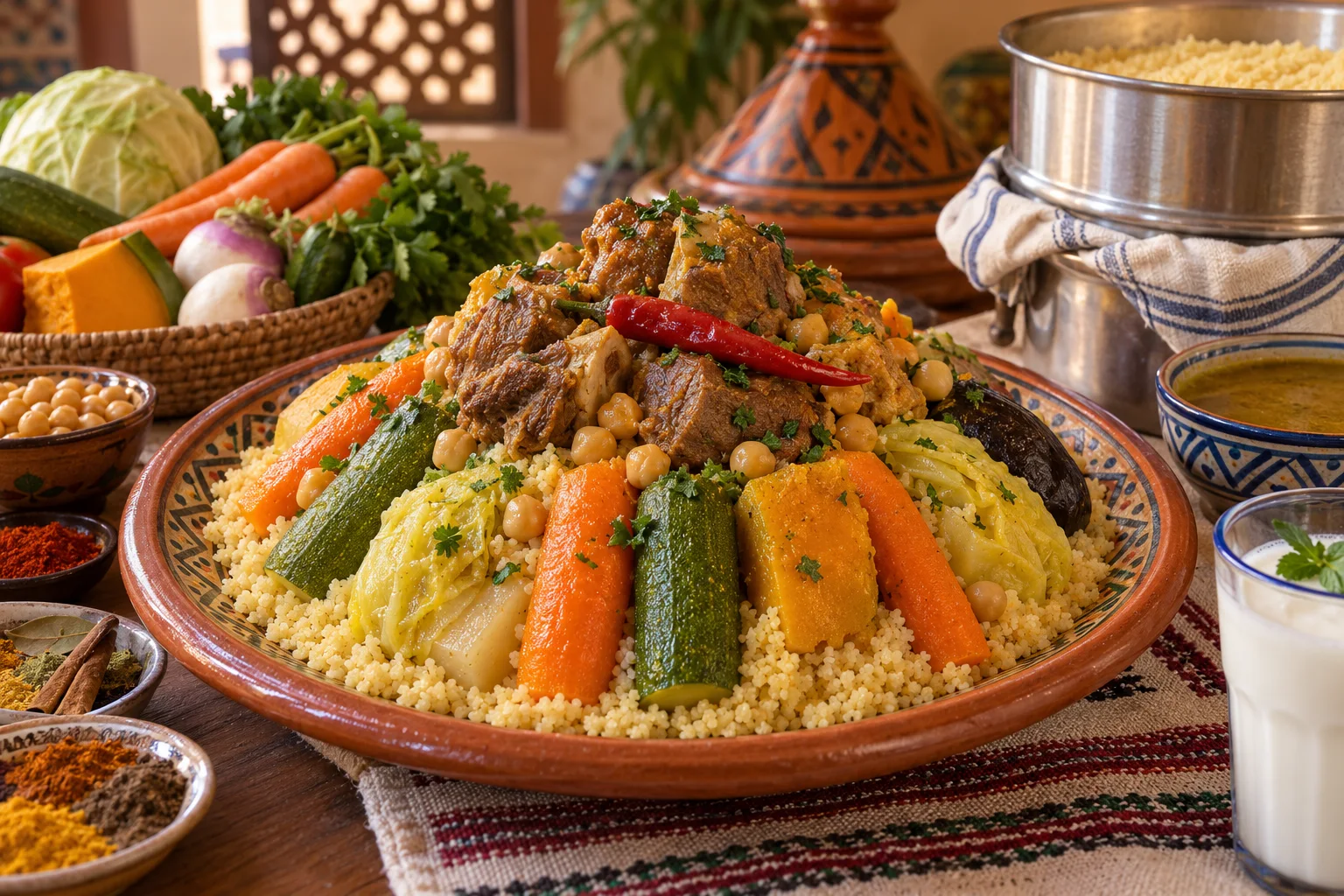
A traditional Moroccan couscous recipe is very different from simply pouring hot water over instant couscous. In Moroccan homes, the grains are traditionally prepared slowly in a couscoussier, where they are steamed several times above a broth of meat, chickpeas and vegetables.
Between steamings, the couscous is worked gently by hand so the grains remain separate and gradually become tender and plump. The vegetables are added according to how long they need to cook, and the finished dish is assembled on one large platter for everyone to share.
For many Moroccan families, couscous is especially associated with Friday. It is not only a recipe but a family meal surrounded by habits of sharing, hospitality and eating together.
This guide explains how to make Moroccan couscous using the traditional repeated-steaming method, along with the small details that are often missing from quick versions of the recipe.
What Is Traditional Moroccan Couscous?
Couscous is made from tiny granules traditionally prepared from durum-wheat semolina. In Morocco, however, the word can describe much more than the grain itself. A full couscous meal combines the steamed grains with broth, vegetables, chickpeas and usually meat.
Beef, lamb and chicken can all be used. The vegetables change according to the household, region and season, but carrots, turnips, courgettes, pumpkin and cabbage are common choices.
When fresh fava beans are in season, they can also be added. This is one of the pleasures of couscous: the basic technique remains recognizable while the vegetables can follow what is fresh and available.
Moroccan Couscous Ingredients
The quantities below make a generous family-size couscous. Moroccan households may intentionally prepare more than the exact number of people sitting at the table, especially when a portion will be shared with someone else.
For the Couscous
- 750 g to 1 kg fine or medium couscous
- Olive oil for coating and separating the grains
- Water, as needed between steamings
- Salt, as needed
- Smen for the final seasoning
For the Meat and Broth
- 500 to 700 g beef, lamb or chicken
- About 150 g dried chickpeas, soaked before cooking
- About 1 Moroccan tea glass of olive oil
- Vegetable oil can be used if olive oil is unavailable or not preferred
- Onion, grated
- Tomatoes, blended or finely ground into a liquid
- Garlic
- Parsley
- Fresh coriander
- About 1 liter hot water to begin, with more added as necessary
Spices and Aromatics
- Turmeric
- Cumin
- Ground ginger
- Black pepper
- Saffron
- Salt
- A cinnamon stick
- Bay leaves
- Cloves
The exact amount of seasoning can be adjusted to the amount and type of meat being used. Moroccan home cooking is not always measured spice by spice with teaspoons; cooks often adjust the seasoning according to experience, aroma and the quantity in the pot.
If you want to understand how Moroccan spice blends differ from the individual spices used in couscous, read our guide to Ras el Hanout and Moroccan spice blends.
Vegetables
- Carrots
- Turnips
- Courgettes or zucchini
- Pumpkin
- Cabbage
- Eggplant, if desired
- Fresh fava beans when in season
You do not need an identical number of every vegetable. Choose a balanced mixture according to the size of your pot, what is available at the market and what your family enjoys.
The Couscoussier: The Key to Traditional Moroccan Couscous
Traditional Moroccan couscous is prepared in a couscoussier. The lower pot holds the meat, vegetables and broth, while the perforated upper section holds the couscous.
As the broth cooks below, steam rises through the grains. This is why the traditional method produces a different texture from instant couscous that is simply soaked in hot water.
There is one small but important detail: do not let the steam escape through the joint between the two parts of the couscoussier.
In Moroccan kitchens, a strip of clean cloth can be wrapped carefully around the joint between the lower pot and upper steamer. This helps seal the gap and directs the steam upward through the couscous instead of allowing it to escape from the sides.
Keep the cloth securely away from the flame or heating element.
Step 1: Prepare the Chickpeas
If you are using dried chickpeas, soak them ahead of time so they have enough time to soften during cooking. About 150 g dried chickpeas is suitable for this family-size recipe.
Step 2: Start the Meat and Spiced Broth
Place the lower part of the couscoussier over the heat. Add the olive oil and meat.
Season the meat with turmeric, cumin, ginger, black pepper, saffron and salt. Add the cinnamon stick, bay leaves and cloves. Fry the meat carefully so it begins to develop flavor without burning the spices.
Next, add the grated onion, blended tomato and garlic. Let everything cook together for a short time so the onion and tomato combine with the meat and spices.
Tie the parsley and coriander together into a small bundle and add it to the pot. Keeping the herbs tied makes them easier to remove later while allowing their flavor to enter the broth.
👉 Learn more about the seasonings: A Guide to Moroccan Spices and Their Uses
Step 3: Add the Chickpeas, Vegetables and Water
Add the soaked chickpeas and the vegetables that require the longest cooking time.
Carrots and turnips can go into the pot earlier. Add about 1 liter of hot water to begin the broth.
Do not treat that liter as a fixed final quantity. The broth is cooking the meat and vegetables while also producing the steam needed to cook the couscous above. Water will be lost during this long process.
Check the liquid during cooking and add more hot water when necessary. You need enough broth to finish cooking the ingredients and enough steam to continue cooking the couscous.
Step 4: Prepare the Couscous for Its First Steaming
Put the dry couscous into a very large shallow dish or bowl. Add a little oil and begin working the grains gently with your hands.
The goal is to coat and separate the grains so they do not form large clumps during steaming. Move your hands gently through the couscous until the grains feel loose and evenly separated.
Transfer the couscous to the upper section of the couscoussier. Do not compress it tightly. Steam needs to move through the grains.
Step 5: First Steaming
Place the couscous steamer over the simmering broth and seal the joint carefully so steam does not escape around the sides.
For this method, allow approximately 40 minutes from the time the couscous is placed over the pot.
Traditional couscous is not cooked only by watching a clock. Pay attention to the grains and the steam as well. With experience, their texture and appearance tell you when they are ready for the next stage.
Step 6: Separate, Salt and Moisten the Couscous
Carefully empty the hot couscous back into the large shallow dish.
Let it cool just enough to handle safely. Separate the grains gently, add salt and begin incorporating water gradually.
Do not pour in a large amount at once. Add water little by little while working through the grains so they absorb the moisture evenly without becoming a wet mass.
As the repeated steaming continues, the couscous will absorb water, swell and become noticeably larger while remaining separate.
Step 7: Second Steaming
Return the couscous to the steamer and place it back over the broth.
The second steaming can again take around 40 minutes. Continue monitoring the broth below and add hot water if the liquid level becomes too low.
After steaming, return the couscous to the dish again. Separate the grains and add more water gradually according to how much moisture they still need.
Step 8: Add the Quick-Cooking Vegetables Later
Not every vegetable belongs in the pot from the beginning.
Courgettes, cabbage and pumpkin should be added later because they cook faster and can become too soft or break apart if they spend as long in the broth as carrots and turnips.
Fresh fava beans can also be included when they are in season. Adjust the timing according to their tenderness.
This staggered cooking is an important part of producing a platter where the vegetables are tender but still recognizable when they are arranged for serving.
Step 9: Third and, If Needed, Fourth Steaming
Moroccan couscous may be steamed three or four times, depending on the couscous and how it develops.
Later steamings generally take around 25 to 35 minutes. Again, these times are a guide rather than an absolute rule.
Between steamings, check the couscous with your hands and eyes. Add water gradually when it still needs moisture, separate any grains that are sticking together, and return it to the steamer.
The finished couscous should be tender and noticeably expanded, but the individual grains should remain separate rather than becoming a paste.
Step 10: Finish the Couscous with Smen
After the final steaming, return the couscous to the large dish and separate the grains one last time.
At this stage, add smen according to taste and work it gently through the hot couscous. It adds a characteristic richness and aroma to the finished grains.
How to Serve Moroccan Couscous
Traditional couscous is made for sharing, and presentation is part of the meal.
Spread the finished couscous over a large serving platter, traditionally a gasriya. Add some broth around and into the couscous so it absorbs flavor without becoming flooded.
Arrange the cooked vegetables over the couscous. Add the chickpeas, followed by raisins if you want them with this preparation.
Finally, place the meat prominently on top and finish with a red chili pepper if desired.
Keep additional broth available so more can be added according to each person's preference.
What Is a Gasriya?
A gasriya is a large traditional Moroccan dish used in the home. It can be used while preparing bread and also makes an ideal communal serving platter for couscous.
For Friday couscous, the gasriya is placed where the family gathers, and everyone eats from the same dish rather than receiving an individually plated restaurant-style portion.
Friday Couscous in a Moroccan Home
To understand Moroccan couscous, it helps to understand Friday.
In many Moroccan families, Friday couscous is a weekly tradition connected with the family gathering around the time of Jumu'ah, the Friday prayer. Preparing and eating the dish is as important socially as the recipe itself.
Traditionally, adults may eat couscous with the fingers of the right hand, while children can use spoons, especially while the food is still very hot. Today, of course, families may use whichever method they prefer.
When everyone shares one gasriya, each person normally eats from the section directly in front of them rather than reaching across the platter.
The meat placed in the center or on top is often kept until later in the meal rather than being taken immediately. When the time comes, it can be divided among the people sharing the platter.
There is also a sense that the meal is finished together. In the tradition described here, someone who finishes eating does not immediately leave their place while everyone else continues. The shared meal emphasizes staying together until the others have finished.
What Do Moroccans Drink with Couscous?
In the traditional meal described here, the classic accompaniment is buttermilk, known in Morocco as lben.
Visitors sometimes expect Moroccan mint tea to accompany every Moroccan dish, but Friday couscous has its own habits. Lben provides a cool, slightly tangy contrast to the hot couscous and rich broth.
Friday Couscous Is Also About Sharing
A Moroccan household may prepare more couscous than the number of people eating at home requires.
An extra portion can be sent to a neighbor, a young person living alone, an older person nearby, or someone in need. Food can also be offered to a person experiencing homelessness.
This helps explain why the large communal platter matters. Couscous is not only about feeding the people already sitting around the table. Preparing enough to share can turn the Friday meal into a small act of neighborhood solidarity.
Buying Couscous Vegetables in Morocco on Friday
If you are shopping in Morocco on a Friday, you may notice that vegetable sellers understand exactly what customers mean when they are shopping for couscous.
In many markets and neighborhoods, sellers offer a mixture of the vegetables commonly used for couscous. Instead of buying a large quantity of every vegetable separately, you can choose a selection of carrots, turnips, courgettes, pumpkin, cabbage and other available vegetables and pay according to weight.
Friday prayer also gives the neighborhood a particular commercial rhythm. Around busy mosques and nearby streets, informal fruit and vegetable sellers may appear around prayer time, and shopping can become especially active after the prayer finishes.
For a visitor, this can be an interesting glimpse of how the Friday meal connects the kitchen, neighborhood market and weekly religious rhythm.
Vegetable Couscous and Couscous Tfaya Are Not the Same Dish
One distinction visitors should know is the difference between ordinary vegetable couscous and couscous with tfaya.
The vegetable couscous described in this recipe is built around broth, vegetables, chickpeas and meat.
Couscous tfaya is another preparation. It is known for its sweet character, particularly the tfaya made with onions and raisins, and is served with meat rather than simply being the vegetable version with a sweet topping added to it.
Some restaurants may combine elements for presentation or to offer tourists more ingredients on one plate, but that should not be confused with the way the two styles are traditionally distinguished in Moroccan homes.
A Tip for Ordering Couscous in Morocco
If you are visiting Morocco and want couscous closer to a traditional home-style preparation, ask the restaurant or hotel what type of couscous it serves.
You can ask specifically for vegetable couscous or couscous with tfaya rather than assuming every large mixed restaurant platter represents one traditional style.
And if traditional couscous is available on Friday, that is an excellent time to try it.
Common Mistakes When Making Moroccan Couscous
Treating It Like Instant Couscous
Pouring boiling water over couscous can make a quick side dish, but it does not reproduce the traditional Moroccan method described here. Repeated steaming changes the texture and allows the grains to develop gradually.
Skipping the Hand Separation
The work between steamings matters. Oil, water and salt need to be distributed while the grains are gently separated. This helps prevent clumping and encourages even absorption.
Adding All the Vegetables at Once
Pumpkin, cabbage and courgettes do not need as much cooking as harder vegetables such as carrots and turnips. Adding everything together can leave the delicate vegetables broken and overcooked.
Letting Steam Escape from the Couscoussier
If steam pours from the joint between the two pots instead of moving through the couscous, the grains will cook less efficiently. Seal the joint carefully and safely.
Forgetting to Check the Broth
The lower pot is doing two jobs at once: cooking the meal and producing steam. Check it throughout the process and replenish it with hot water when necessary.
Moroccan Couscous FAQ
How many times should Moroccan couscous be steamed?
For the traditional method described here, couscous is steamed three to four times. The first two steamings can take around 40 minutes each, while later steamings may take approximately 25 to 35 minutes. Texture and appearance matter as much as the clock.
What meat is used in Moroccan couscous?
Beef, lamb and chicken are all traditional choices. You do not need to use the same meat every time.
What vegetables go in Moroccan couscous?
Carrots, turnips, courgettes, pumpkin and cabbage are common choices. Eggplant can also be used, and fresh fava beans are particularly enjoyable when they are in season.
Can I make Moroccan couscous without a couscoussier?
You can prepare couscous using other equipment, but a couscoussier is the traditional tool designed specifically for cooking the broth below while steaming the grains above. If you want to reproduce the method in this recipe closely, a couscoussier is the best choice.
Why is my couscous clumpy?
Clumping can happen when the grains are not separated sufficiently, when water is added too quickly, or when the couscous is compressed in the steamer. Add moisture gradually and work through the grains gently between steamings.
Is Moroccan couscous spicy?
Traditional couscous can be richly spiced without necessarily being chili-hot. Ginger, turmeric, cumin, saffron and black pepper contribute aroma and warmth, while a red chili can be added according to taste.
Do Moroccans eat couscous every Friday?
Friday couscous is a deeply familiar tradition in Morocco, although individual households naturally have different routines. For many families, Friday remains the day most strongly associated with preparing couscous and sharing it together.
Is couscous tfaya the same as vegetable couscous?
No. They are distinct styles. Vegetable couscous is centered on the vegetable-and-meat broth, while couscous tfaya is known for its sweeter onion-and-raisin preparation served with meat.
More About Moroccan Couscous
The cooking method is only one part of the story. Couscous has a much wider history across Morocco and North Africa and has developed different traditions over generations.
👉 Explore the cultural story: The Surprising History of Moroccan Couscous
Final Thoughts
Making traditional Moroccan couscous takes time. The grains are oiled, separated by hand, steamed repeatedly, moistened gradually and finally finished with smen. Meanwhile, the meat, chickpeas and vegetables cook below and create the broth that powers the steaming process.
But the technique alone does not explain why couscous matters in Morocco.
A Friday gasriya can bring an entire family around one platter. People eat from their own place, share the meat, drink lben and remain together as the meal finishes. An extra plate may leave the house for a neighbor or someone who needs it.
That is why a real Moroccan couscous recipe is difficult to reduce to semolina, vegetables and cooking times. The food matters, but so do the steam rising from the couscoussier, the large shared gasriya and the people gathered around it.

CONVERSATION