
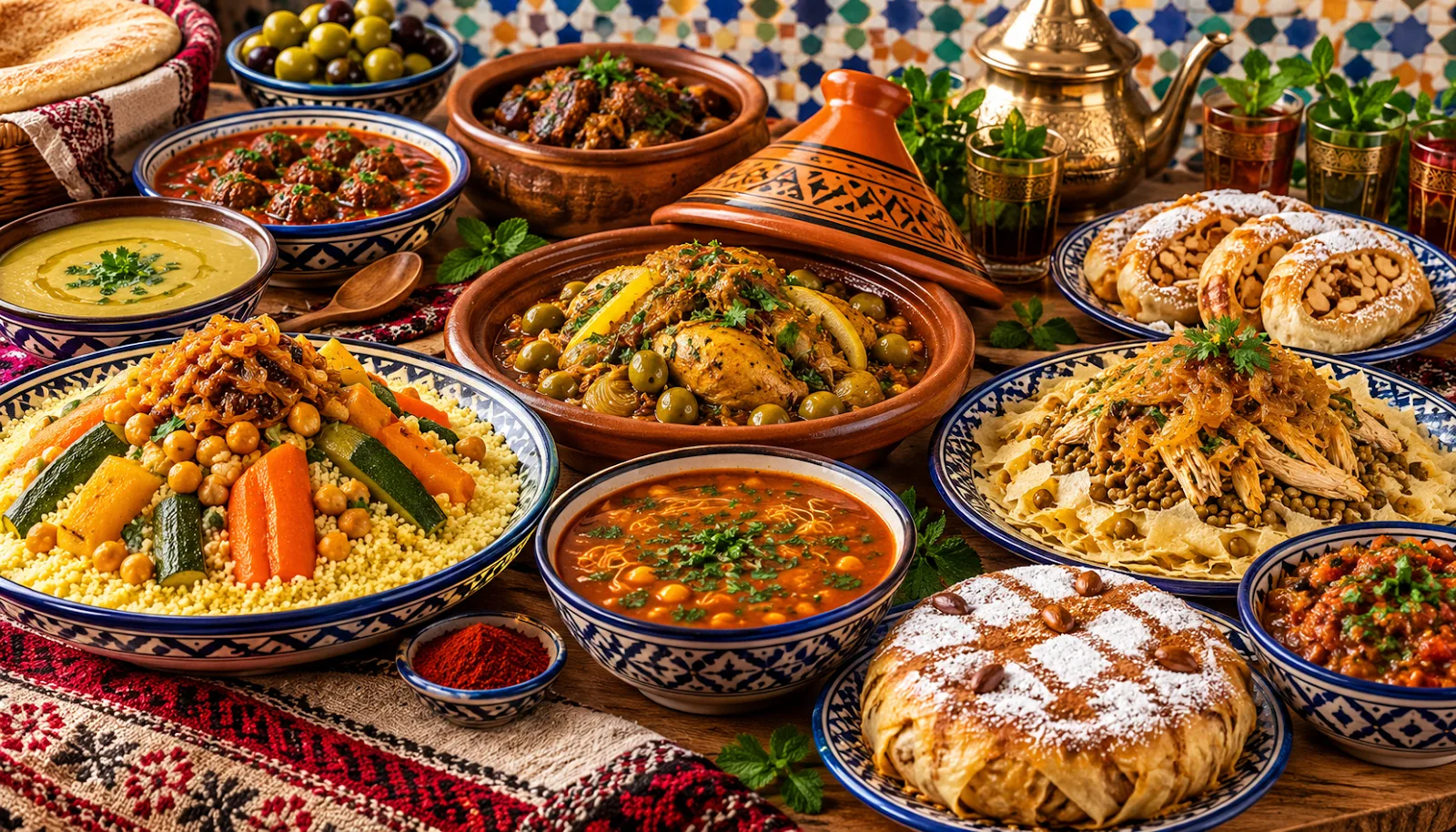
A Moroccan table tells you a great deal about the occasion before anyone takes the first bite. A broad dish of couscous at Friday lunch, a bowl of harira at sunset during Ramadan, or the crisp pastry of a pastilla brought out for guests all belong to the same cuisine. Yet they demand different skills, ingredients and amounts of patience. There is no single seasoning, cooking vessel or presentation that makes a dish Moroccan.
That variety is what makes traditional Moroccan food worth understanding beyond the familiar photographs. The grain in couscous has to be steamed properly; the sauce in a tagine should have enough concentration to be eaten with bread; and a cooked salad such as zaalouk depends on reducing the vegetables rather than simply mixing them. The ten dishes below move from the everyday table to regional customs and celebrations. They are introductions to foods you might order, share or learn to cook, with links to full methods where My Morocco has published them, not ten abbreviated recipes pretending a few sentences can replace the work.
The Everyday Table: Steam, Slow Cooking and Simple Ingredients
In an ordinary Moroccan kitchen, much of the flavour comes from the way ingredients are handled. Broths develop as vegetables cook, spices are added in relation to the dish rather than by a fixed formula, and even humble beans can become a satisfying meal when given enough time.
1. Couscous: More Than Steamed Semolina
Couscous is especially associated with Friday lunch, when a large communal dish often brings the family together. The grains are separated with a little oil, moistened and steamed in a couscoussier above the broth. They are worked again between steams so the finished couscous stays light and distinct. Pouring boiling water onto dry grains may make a quick side dish, but it does not reproduce the texture of the traditional preparation.
Underneath that apparently simple mound of couscous lies another kind of judgement. Beef, lamb or chicken may be cooked with chickpeas, onions, tomato and a changing selection of vegetables. Carrots and turnips can withstand longer cooking; courgettes and pumpkin are added later so they do not disappear into the sauce. The vegetables are arranged above the grains and the broth is served generously enough to flavour them without turning the whole dish into soup. The individual steaming stages, quantities and cooking order are set out in our authentic Moroccan couscous recipe.
2. Tagine: A Cooking Method with Many Expressions
A tagine is both a cooking vessel and the name given to an enormous family of Moroccan dishes. This distinction matters. Chicken cooked with preserved lemon and olives has little in common with a lamb-and-prune tagine beyond certain principles of slow cooking. A fish tagine, meanwhile, may depend on chermoula, tomatoes, peppers and a quite different cooking time. Treating them all as one dish with the same powdered spice mix erases the decisions that make each version work.
The characteristic clay vessel encourages moisture to circulate while the ingredients cook together gently. Water is used with restraint; the aim is usually a sauce that clings to the meat or vegetables, not a deep pool of stock. Harder vegetables may be placed where they can cook longer, and fish must be protected from the prolonged heat suitable for tougher meat. At the table, bread is commonly used to share the sauce and pieces of food. Tagine is not automatically served on top of couscous. For the range of preparations, our Moroccan tagine guide is a better starting point than any one universal formula.
3. Harira: The Soup Built in Layers
Harira is closely associated with the moment the fast is broken during Ramadan, though Moroccan households also prepare it outside the holy month. Its familiar character comes from tomatoes, soaked chickpeas, lentils, celery, parsley, coriander and a carefully seasoned broth. Meat, vermicelli or rice appear in some versions, and recipes differ in the way they develop body. A good harira is substantial but still recognisably a soup: you should be able to taste the legumes and herbs rather than just a thickened tomato base.
The order of cooking is important because lentils, chickpeas and any added pasta do not soften at the same rate. The fresh herbs contribute their fragrance to the broth; the final thickening, where used, should bind the soup without making it pasty. Dates and chebakia are familiar companions during Ramadan, sometimes joined by eggs according to household custom. Those combinations make sense at the table as part of a meal, not as mandatory garnishes in the pot. Our Moroccan harira soup guide covers the preparation in greater detail.
4. Zaalouk: Why a Moroccan Salad Can Be Cooked
Calling zaalouk an aubergine salad can mislead someone expecting raw vegetables. The aubergine is cooked until tender, then combined with tomatoes, garlic, olive oil, cumin and paprika. Some versions begin with roasted aubergines; others cook the vegetable directly. Either way, the point is to bring the ingredients together while allowing excess moisture to evaporate. The resulting mixture should be soft and cohesive, with enough texture to make each bite interesting.
Zaalouk is often placed on the table in a small dish, eaten warm or at room temperature with bread. It may accompany grilled fish, meat or a larger Moroccan meal. It rewards attention to an apparently minor step: reducing the tomato liquid. Leave too much behind and the bread becomes wet before it can pick up the flavours. In our guide to Moroccan salads, zaalouk sits alongside other cooked and fresh preparations, showing how varied the idea of a salad can be.
5. Bissara: A Bowl That Needs No Ceremony
There is a different pleasure in bissara, a warm preparation of dried fava beans or split peas, depending on the place and the household. The pulses cook slowly until they can be blended or mashed into a smooth, thick soup or purée. Olive oil and cumin may be added at the table, with bread ready for dipping. The ingredients are inexpensive, but the texture depends on cooking them fully and adjusting the liquid rather than rushing the pot.
It is especially welcome on cold mornings, when the bowl itself does much of the work of breakfast. Bissara also provides a useful correction to the impression that Moroccan food must always be richly spiced or elaborate. Sometimes the most recognisable flavours are beans, olive oil, cumin and good bread, served hot and without decoration.
Where Food Carries a Place or a Family Tradition
Other dishes are inseparable from the setting in which people prepare them. Marrakech tanjia is tied to the city's neighbourhood cooking traditions, while rfissa belongs to the kind of generous home meal whose meaning is as important as its ingredients.
6. Tanjia: The Slow Rhythm of Marrakech
Tanjia belongs particularly to Marrakech. Unlike the shallow tagine, the tanjia is traditionally cooked in a tall earthenware jar. Meat is seasoned with ingredients that may include garlic, saffron, smen and preserved lemon, then left to cook slowly until it becomes exceptionally tender. The sauce is usually concentrated, rich with the flavours released during the long cooking, rather than built around a large quantity of vegetables.
The social rhythm is part of the dish. In Marrakech, friends may prepare a tanjia after the Dhuhr prayer and arrange to eat it after Isha, giving it hours to cook in the gentle heat of a traditional furnace. Versions differ: beef and lamb are well known, and chicken tanjia also has its place. The goal is the same tenderness, with meat that gives way easily and a sauce worth sharing with bread. The city's markets and traditional cooking arrangements are explored further in our account of Marrakech street food and tanjia.
7. Rfissa: The Broth Is as Important as the Chicken
To understand rfissa, look beneath the chicken. Torn pieces of thin trid, or another suitable homemade flatbread such as msemen in some versions, are spread across a generous serving dish. They absorb a broth made with chicken, onions, lentils and distinctive seasonings, including fenugreek. What looks at first like bread under a stew is actually a carefully balanced dish: the bread must soften and become fragrant without dissolving into a soggy mass.
In the home-style rfissa l3amia method, the whole chicken cooks in the seasoned broth and is served directly from it. Roasting the chicken afterward belongs to a different preparation and should not be presented as a required final step for rfissa. The dish is especially associated with colder months and is also prepared in some Moroccan families for a mother after childbirth, a cultural tradition rather than a medical claim. Rfissa asks the cook to think about the consistency of the sauce as much as the tenderness of the chicken: everything has to come together on the plate.
Celebrations, Hospitality and the Sweet Finish
At a celebration, Moroccan cooking changes scale. Mechoui can occupy an entire oven and a gathering of guests; pastilla relies on the quiet work of preparing fillings separately. Pastry then carries the meal toward tea, where almonds and orange blossom water take over from meat and broth.
8. Mechoui: Roasting Lamb with Patience
Mechoui is often associated with weddings, significant family gatherings and meals prepared for many people. In its traditional large-scale form, a whole lamb or sheep is roasted slowly in a specialised oven or roasting pit. That method is quite different from putting seasoned lamb chops in a domestic oven. The size of the animal, the heat source and the long cooking time all shape the texture.
When it is done well, the meat should pull away tenderly, with the roasted exterior offering a contrast to the softer pieces beneath. It is frequently eaten with bread, salt and cumin, without a complicated sauce that would distract from the lamb. Smaller oven-roasted cuts can be delicious, but they are better described as home adaptations rather than the same ceremonial preparation. Our Moroccan mechoui guide explains the distinction and a more practical route for home cooks.
9. Pastilla: The Discipline Behind Sweet and Savoury
Pastilla, also written bastilla, is one of the clearest examples of Moroccan celebration cooking. Chicken or, in traditional versions, pigeon is cooked and shredded; the onion-and-egg filling is prepared separately; almonds are fried or toasted and mixed with sugar and cinnamon according to the version. The elements meet inside fine warqa pastry, whose crispness is meant to contrast with the rich filling. Sweetness here is not an accidental garnish. It is part of a deliberate balance.
Much of the work lies in knowing when each component is ready to assemble. A watery onion mixture will soften the pastry, and an overly smooth almond filling loses its pleasant bite. The pastry should come from the oven golden and crisp enough to break cleanly. Seafood pastilla is another familiar version, but it follows a different flavour direction and should not be confused with the sweet-spiced chicken or pigeon filling. See the full Moroccan pastilla preparation for the layers and assembly.
10. M'hanncha: Almonds, Pastry and a Spiral
The name m'hanncha refers to the shape of a snake, an apt description of this long pastry rolled into a coil. A fragrant mixture of ground almonds, sugar, cinnamon and orange blossom water is wrapped in thin pastry before being wound into a spiral and baked. The technique creates a crisp outer shell around the softer almond centre; the pastry is not simply a sweet filling poured into a round dish.
Some versions are brushed with honey or syrup, while others allow the almonds and orange blossom to remain the leading flavours. M'hanncha belongs naturally among pastries offered with tea or served when guests visit. It closes this selection for a reason: the patience behind Moroccan cooking is as visible in the delicate handling of almond pastry as it is in the long steaming of couscous or the slow cooking of tanjia.
Which Moroccan Dish Should You Try First?
Choose by what interests you, rather than treating these ten dishes as a checklist. For the craft of everyday cooking, begin with couscous, harira or zaalouk; each teaches something different about steam, broth or reduction. Tagine shows how a small amount of liquid can build a satisfying sauce, while bissara proves that a humble pulse can carry a meal. In Marrakech, take the opportunity to try tanjia in the city whose traditions shaped it.
For dishes tied to family and hospitality, rfissa, mechoui and pastilla tell very different stories. M'hanncha offers a fitting finish with tea. None is a substitute for another, and none can be reduced to a handful of generic spices. If you decide to cook one, follow its dedicated method and learn the decisions behind it. That is a more rewarding way to discover Moroccan food than memorising ten names.

CONVERSATION