
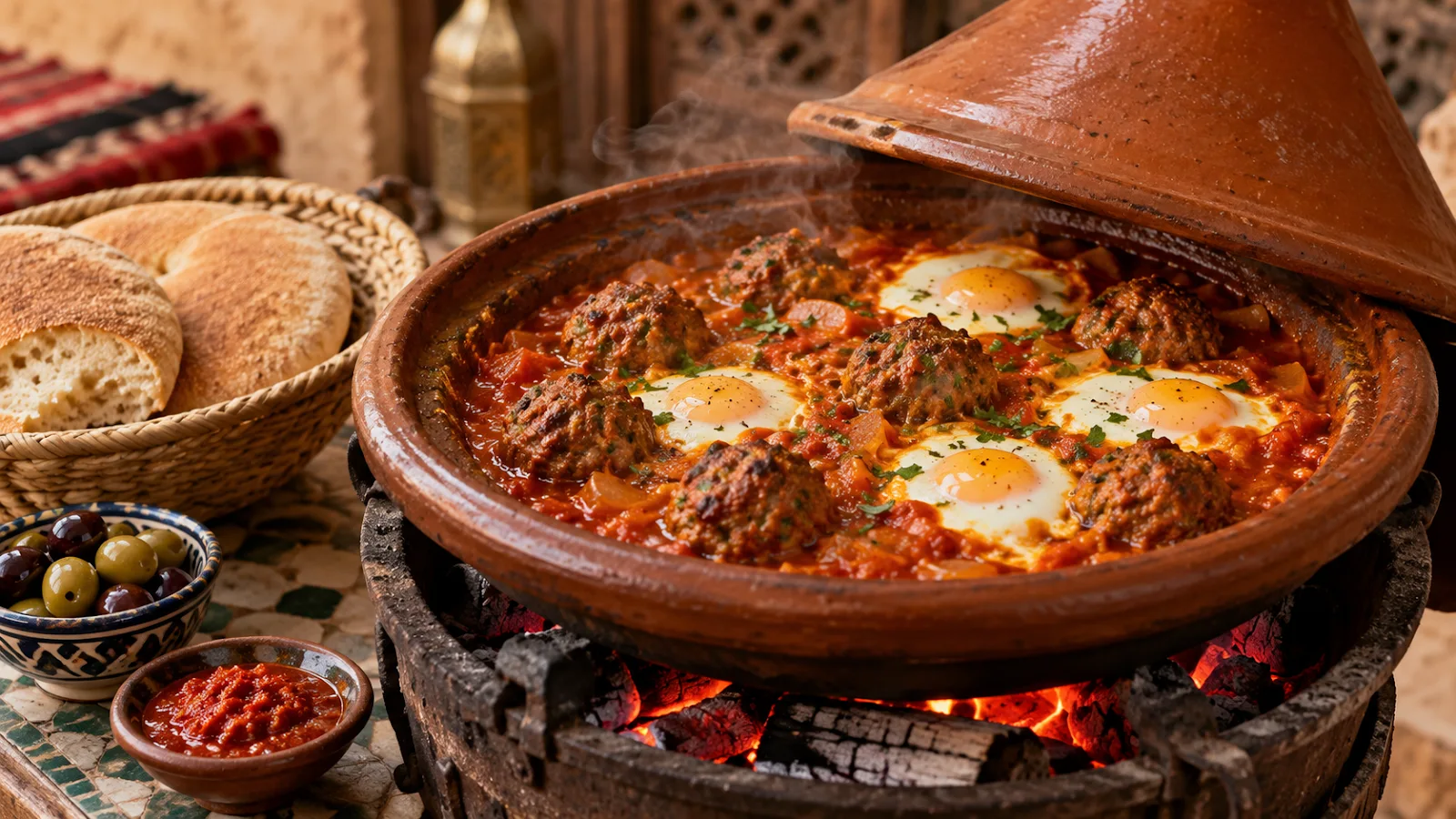
There are Moroccan dishes where the meat carries most of the seasoning, and there are others where the sauce does the work. Tagine Kefta belongs to the second group. In the version I grew up with, the minced meat is kept almost completely untouched: good lamb and salt are enough. The tomatoes, onion, garlic, fresh herbs and spices are cooked separately around it, creating the strong sauce that gives the finished tagine its character.
That simplicity is one of the reasons I like this dish. Nothing is added simply to make the recipe look richer. The kefta cooks directly in the tomato sauce, absorbing some of its flavor while releasing its own juices and fat into the tagine. Eggs come only at the end, after the fire has already been turned off, and finish gently beneath the lid from the heat and steam still trapped inside the clay.
Lamb is the meat I consider traditional for Tagine Kefta, although beef has become very common and Moroccan families now also prepare versions with chicken or turkey. The principle remains the same: keep the meat simple and let the sauce carry the seasoning.
Moroccan Tagine Kefta with Tomato Sauce and Eggs
Cuisine:
Moroccan
Category:
Main Course
Cooking time:
The Ingredients
For this tagine, the ingredient list is deliberately simple. The meatballs themselves need only minced meat and salt. All of the parsley, coriander, garlic and spices go into the tomato sauce instead.
- 450-500 g minced lamb, traditionally, or beef, chicken or turkey
- Salt for the kefta
- 2 large tomatoes, grated or finely prepared
- 1 large onion, sliced
- 2 garlic cloves, crushed or finely chopped
- Fresh parsley, chopped
- Fresh coriander, chopped
- Cumin
- Paprika
- Turmeric
- Ginger
- Black pepper
- Salt for the sauce
- About 1 tablespoon of the combined spices
- ¼ Moroccan tea glass olive oil
- 3 to 4 eggs, depending on the size of the tagine
Older versions of the dish are especially straightforward. There is no breadcrumb, rice or egg mixed into the kefta. More recently, some families have begun adding breadcrumbs, rice or even Chinese vermicelli to minced meat. Those versions exist, but when I want traditional Tagine Kefta, I leave the meat clean. The sauce has enough ingredients and enough flavor already.
How I Cook Tagine Kefta
I start with the sauce rather than the meatballs. The sliced onion goes into the tagine with the olive oil, followed by the tomatoes and garlic. Parsley, coriander, cumin, paprika, turmeric, ginger, black pepper and salt are added here as well.
This first stage deserves some patience. The tomatoes should not simply become hot before the meat goes in. I let the onion soften and the tomato cook down until the ingredients begin coming together as one sauce. At first there is quite a lot of liquid from the tomatoes, but as the tagine cooks, that excess moisture gradually disappears and the flavor becomes stronger.
What I am looking for is a sauce that has begun to thicken but still has enough moisture to finish cooking the meatballs. If the kefta is added while the tomato mixture is still watery and undeveloped, the finished dish will taste more like meatballs sitting in tomato liquid than a proper Tagine Kefta.
While the sauce is cooking, I prepare the kefta. The minced lamb gets only salt. I do not mix the sliced onion, herbs, garlic or spices into the meat because all of those flavors are already developing in the tagine.
The size of the meatballs depends partly on the family. When children are eating with us, I usually make them smaller. For adults they can be a little larger. There is no need to measure every meatball exactly, but keeping them reasonably similar helps them cook at the same pace.
Once the tomato sauce has developed, the raw meatballs go directly into it. They are not fried beforehand and they are not grilled separately. They cook where they will eventually be served, surrounded by the sauce.
After adding the kefta, I let it cook for approximately 10 to 15 minutes. This is also when the sauce reaches its final consistency.
The meat releases some juice and fat as it cooks, especially when using lamb, and that becomes part of the sauce. By the time the meatballs are ready, the sauce should be strong and noticeably thicker than it was at the beginning. It should sit around the meatballs rather than look like a thin broth.
From the moment the tagine begins cooking until this stage is finished, the complete cooking process takes around 35 to 40 minutes. The exact pace can change slightly with the size of the tagine and the strength of the heat, so I pay more attention to the sauce and the meat than to the clock alone.
The eggs are added only when the kefta is cooked and the sauce is ready. At that point, I turn off the fire first.
Then I crack three or four eggs over the tagine, depending on its size, and put the lid back on immediately. I do not continue cooking them over the flame. A clay tagine stores a surprising amount of heat, and once it is covered, the steam and heat remaining inside are enough to finish the eggs gently.
This small detail makes a difference. Keeping the tagine over the fire while waiting for the eggs can continue reducing the tomato sauce unnecessarily. By turning off the heat first, the sauce stays where I want it while the whites set from the heat already inside the tagine.
Why I Keep the Meat Simple
A lot of recipes season meatballs heavily before they ever reach the pan, but that is not how I prefer Tagine Kefta. Here, the contrast is important. The lamb remains simple while the sauce is aromatic and heavily seasoned.
When you take a piece of kefta with Moroccan bread, you are not eating the meat alone. You pick up some of the thick tomato sauce with it. That means the seasoning reaches every bite without needing to fill the meat with the same ingredients.
This also lets lamb taste like lamb. When beef, chicken or turkey is used instead, the same principle still works, although each meat changes the final character of the tagine slightly.
The Eggs Are Part of the Finish, Not the Sauce
Eggs are common in the version of Tagine Kefta I know, but they are treated differently from the meatballs. They do not simmer in the tomato sauce for a long time. They sit on top, added at the last moment.
The number depends on the tagine. Three can be enough for a smaller one, while a larger tagine can take four. Once the lid is closed, I leave them alone and allow the remaining heat to do the work.
The result should still clearly look like Tagine Kefta: meatballs sitting in a concentrated tomato sauce with the eggs resting over them, rather than eggs broken apart and mixed throughout the dish.
How We Eat Tagine Kefta
At the table, I serve it directly in the tagine. There is no need to transfer everything into another serving dish because the tagine itself is part of the meal.
The accompaniment is Moroccan bread. We tear pieces of bread and use them to pick up the kefta, egg and thick tomato sauce together. Around the main tagine, there can be small salads, olives and some harissa for anyone who wants more heat.
I would not normally serve this dish with couscous or rice. Tagine Kefta already has its own way of being eaten, and bread is what makes sense with the concentrated sauce left at the bottom.
Cooking It in a Traditional Clay Tagine
The pot itself also affects how I cook this dish. A traditional clay tagine does not like aggressive heat or sudden temperature changes. Gentle cooking allows the sauce to reduce while the clay distributes the heat slowly through the base.
If you are using a new tagine, it should also be prepared before its first meal. I soak a new clay tagine completely in water for 24 hours, let it dry, and then rub it with a little olive oil. Once it has been prepared this way, it can be used whenever needed.
During cooking, I never pour cold water into a very hot tagine. The same rule matters after the meal: I do not take a hot tagine from the fire and immediately place it on a cold kitchen surface or wash it with cold water. Those sudden temperature changes are one of the easiest ways to crack clay.
I also prefer the plain traditional clay tagines for cooking. Colorful decorated tagines absorb less water and, although their decoration can be made with natural materials, older people in Morocco often prefer the original uncolored clay for actual cooking. I do too. A colorful one can be beautiful for serving: you can cook the meal in the plain tagine and move it to the decorated one at the table.
When buying one, I look closely for fine lines, small holes or weak areas in the clay because these can eventually allow sauce to leak out or cause the pot to break sooner. I also ask where it was made. In my experience, Safi and Salé are especially known for good clay.
I explain this in more detail in my guide to choosing, preparing and using a Moroccan tagine pot. For other traditional preparation methods, explore our Moroccan cooking techniques collection.
A Few Questions People Often Ask
Which meat is traditional for Moroccan Tagine Kefta?
The original version I know uses lamb. Beef is also very common today, while chicken and turkey are newer alternatives.
Do Moroccan meatballs contain breadcrumbs?
Not in this traditional version. I use minced meat and salt only. Some modern versions include breadcrumbs, rice or Chinese vermicelli, but they are additions rather than part of the method I grew up with.
Where do the herbs and spices go?
Into the sauce. The parsley, coriander, garlic and spices cook with the tomato and onion, while the meat stays simple.
How long does Tagine Kefta take to cook?
The complete cooking time is approximately 35 to 40 minutes. The meatballs themselves spend roughly 10 to 15 minutes cooking in the developed tomato sauce.
Should the eggs continue cooking over the fire?
Not in my method. Once the kefta and sauce are ready, I turn off the fire, add the eggs, cover the tagine and let the stored heat and steam finish them.
Tagine Kefta Among Moroccan Tagines
Tagine Kefta follows the same broad idea as many Moroccan tagines ingredients cooking together slowly in the same vessel, but every tagine has its own logic. A chicken tagine is not simply this recipe with chicken pieces, and a fish or vegetable tagine needs its own seasoning and cooking sequence.
If you want to see how these different dishes fit together, you can continue with my guide to Moroccan tagine recipes. Our traditional Moroccan recipes collection also brings together home-style dishes and familiar ingredients.
For Tagine Kefta itself, I prefer not to complicate things. Let the tomato, onion, garlic, herbs and spices become a good sauce first. Keep the kefta clean. Cook the meatballs directly in that sauce, turn off the fire once everything is ready, and allow the eggs to finish under the lid. With Moroccan bread, a few salads, olives and some harissa on the side, that is already a complete Moroccan meal.

CONVERSATION