
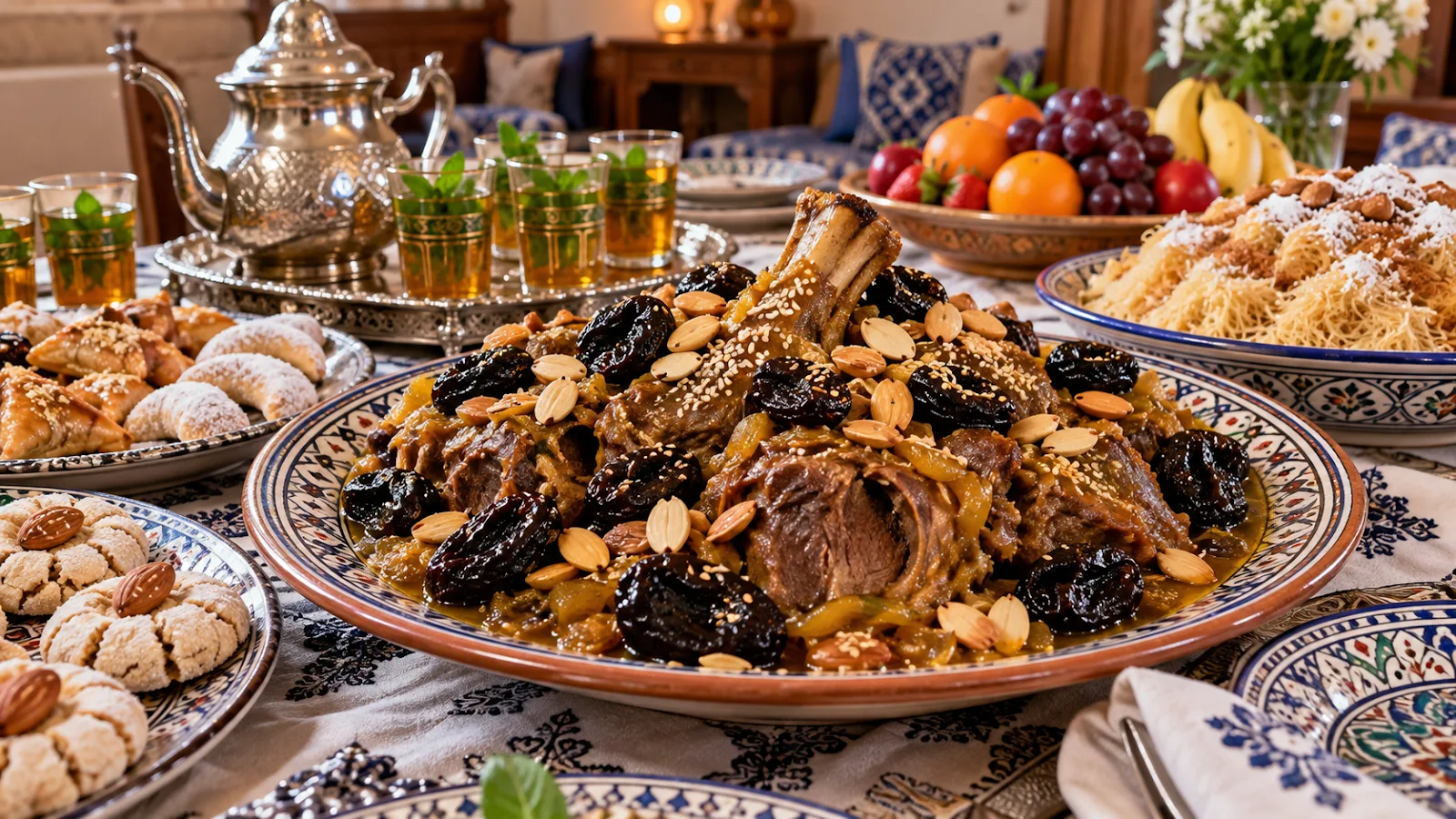
You do not need to turn your house into a Moroccan restaurant to host a memorable Moroccan dinner party. What matters much more is how your guests are received, the order in which food reaches the table, the generosity of the portions, and the time everyone is given to enjoy the evening.
If you are inviting people for a special lunch or dinner, the experience begins before the main meal. Guests arrive, sit down, talk, drink mint tea and eat Moroccan sweets. Only later does the real meal begin.
This guide takes you through the evening step by step so you can create a Moroccan dinner party menu that feels like a real Moroccan invitation rather than a themed restaurant display.
The Moroccan Dinner Party Menu at a Glance
For an important guest dinner, a practical Moroccan-style sequence can look like this:
- Arrival: Moroccan mint tea with pastries and sweets.
- Before eating: guests wash their hands at their seats using the traditional tass hand-washing set.
- First main course: lamb with prunes and almonds or roasted chicken.
- Drinks: cold lemonade or soft drinks with the savory course.
- Second course: seffa with sugar and cinnamon.
- Final course: a large platter of mixed fresh fruit.
- After eating: the hand-washing set can be brought around once again.
Notice what is missing. You do not need five appetizers, a salad course, a tagine, couscous and dessert all at the same dinner.
For an important invitation, the progression is simpler than that, but each course is generous and is given its own moment at the table.
Before Dinner: Welcome Your Guests With Tea and Sweets
Imagine that your guests have just arrived. Do not immediately lead them toward the main meal.
Give everyone time to sit down, greet each other and settle into the house. Bring out the tea tray with the berrad, small tea glasses and a selection of Moroccan sweets.
This first part of the evening may last for some time. There is no reason to rush it just because dinner is waiting.
Moroccan mint tea is not simply another drink on the menu. It is part of welcoming people into the home.
Prepare it using the traditional method in Moroccan Mint Tea Recipe: How to Make Traditional Atay .
With the tea, serve a few Moroccan pastries. Ghriba, kaab el ghazal and almond briouats are all suitable choices.
You can choose the sweets from our guide to Moroccan almond desserts and pastries .
Before the Main Course: Wash Hands at the Table
Before the lamb or roasted chicken reaches the table, another important part of the Moroccan guest experience begins: hand washing.
Moroccan communal meals are often eaten using the hands and pieces of bread, especially when several people share food from the same serving dish. Clean hands are therefore important before the meal starts.
At home with only a few people, everyone can simply wash their hands normally. At a wedding, celebration or large gathering, however, there may be dozens or even hundreds of guests.
Having 100 people leave their places one after another to find a sink would interrupt the meal. Moroccan households and celebrations have a much more practical solution: a portable hand-washing set commonly associated with the tass (الطاس).
What Is a Moroccan Tass Hand-Washing Set?
The traditional set has two important pieces.
The first is the meqraj (المقراج), a pitcher that contains the water used for washing. The water may be warm, and on some occasions it can be lightly scented with orange blossom water.
Underneath is the tass, the basin that receives the used water. A perforated or grated cover sits over the collecting basin so the guest can comfortably hold their hands above it while the water drains underneath.
How the Hand-Washing Ritual Works
A person carries the meqraj, tass and a towel around the table.
Instead of every guest getting up, the server moves from one person to the next. Each guest places their hands over the tass while water is poured from the meqraj. The guest washes their hands and is then offered a towel to dry them.
At a large gathering, the same process continues around the room until everyone is ready to eat.
Only then does the main communal dish arrive.
After the meal, the person carrying the tass may make another round so everyone can wash their hands again without leaving the table.
If you want guests to experience Moroccan hospitality rather than simply look at Moroccan decorations, this small ritual tells them far more about the culture of the meal than another lantern or cushion ever could.
First Main Course: Make It Feel Like a Special Invitation
Once everyone has washed their hands and it is time to eat, a formal Moroccan guest meal normally feels different from an ordinary weekday dinner.
One of the strongest choices is a large communal platter of lamb cooked with prunes and almonds. Roasted chicken is another classic option for receiving guests.
Place the dish in the center of the table so everyone shares the same food rather than receiving individually plated restaurant portions.
Cold drinks can be served at this stage. In Moroccan homes and celebrations, this may simply mean chilled lemonade, cola or orange soft drinks.
You do not need to decorate the meat with edible flowers, microgreens or complicated sauce patterns. The prunes, almonds, meat and sauce already provide the presentation.
Do Not Start a Formal Guest Dinner With Tagine
This is an important distinction if you want the evening to feel closer to Moroccan home hospitality.
Tagine is extremely important in Moroccan cooking, but it belongs much more naturally to ordinary family meals and relaxed gatherings.
For a more formal invitation or when receiving important guests, dishes such as lamb with prunes and almonds or roasted chicken give the meal a more celebratory character.
That does not make tagine less Moroccan. It simply serves a different kind of occasion.
Second Course: Bring Out the Seffa
After everyone has finished the meat or chicken course, clear the table before bringing the next major dish.
Now serve seffa.
For this type of meal, fine vermicelli is presented with sugar and cinnamon. The move from a savory meat course to sweet seffa gives the dinner a real progression rather than placing every dish on the table at the same time.
Bring the seffa as its own course. Do not squeeze it beside the meat as though it were a side dish.
Finish With a Large Fruit Platter
The final course does not need to be another heavy pastry dessert.
Prepare a large platter with several kinds of fresh fruit and bring it to the table after the seffa.
Choose fruit that looks good and is in season. The exact selection is less important than having enough for everyone to share.
After several rich courses, fruit gives the meal a simple and refreshing finish.
What If You Are Hosting a Casual Dinner Instead?
Not every invitation needs the formal menu above.
If you are having close friends or family over for a normal evening, then a tagine is completely appropriate.
You might begin with several small plates of Moroccan salad, serve one tagine with bread as the main dish, finish with fruit, and have tea afterward.
A simple Moroccan salad can be nothing more complicated than tomato with onion or tomato with cucumber.
Instead of putting one huge salad bowl in the center, several small plates can be distributed around the table so everyone can reach them.
For a larger casual spread, you can also choose dishes from 5 Moroccan Appetizers to Impress Your Dinner Guests .
Tagine and Couscous Are Not Automatically Served Together
A common mistake in Moroccan-themed menus outside Morocco is to prepare tagine and then add couscous beside it as though couscous were a standard side dish.
In Moroccan homes, both are substantial dishes in their own right.
If you choose couscous as your main dish, let the couscous be the center of the meal.
Use our complete Moroccan Couscous Recipe if you want to build the dinner around couscous.
Let the Food Look Like Food
One of the easiest ways to make a Moroccan dinner look less authentic is to decorate every plate unnecessarily.
Traditional home cooking usually reaches the table looking much like it did when it finished cooking.
Olives may remain with a chicken dish. Preserved lemon may sit over the meat because it belongs to the recipe. Sesame may be used where it normally belongs.
But you do not need edible flowers, microgreens, sauce dots, geometric molds or complicated vertical plating.
Those techniques are perfectly normal in modern Moroccan restaurants, just as they are in restaurants elsewhere in the world. They are modern chef presentation rather than a requirement of Moroccan home hospitality.
Use the Table You Already Have
You also do not need to buy floor cushions and force your guests to eat on the ground to make the evening “Moroccan.”
Moroccan homes are different from one another.
In large cities, many families use an ordinary dining table with chairs. Other homes have an L-shaped sofa around a low table, commonly called a lmida or tabla.
In rural areas, eating while seated on the floor remains much more common.
If you already have a comfortable dining table, use it. Moroccan hospitality is about making guests comfortable, not creating a theatrical set.
How to Serve Bread
Bread is one of the details that makes the table function properly.
For a relaxed family-style dinner, you can tear the bread into manageable pieces and place them in a salla dial khobz, or bread basket, so guests can help themselves.
Another traditional family arrangement is to leave the loaves near the senior person at the table, who tears and distributes bread to everyone.
For a more formal occasion, smaller individual loaves can be placed in front of each guest.
If somebody finishes their bread and wants more, keep extra bread ready rather than making the guest ask repeatedly.
How to Serve a Tagine at a Casual Dinner
If you do choose tagine for a relaxed gathering, serve it in the same tagine in which it was cooked.
Bring the vessel to the table and place it in the center so the meal can be shared.
The tagine itself is already part of the presentation. There is no need to transfer the food onto a decorative restaurant plate.
Your Moroccan Dinner Party Timeline
The Day Before
- Decide whether you are hosting a formal dinner or a casual one.
- Buy the meat, fruit, drinks, bread and ingredients you need.
- Prepare or purchase Moroccan pastries for the welcome tea.
- Check that you have enough glasses, plates and serving dishes.
- Make sure the tea tray, berrad and tea glasses are ready.
- If you are hosting a large formal meal, prepare the tass, meqraj and clean towels for hand washing.
On the Morning of the Dinner
- Prepare ingredients for the main dish.
- Prepare the ingredients needed for seffa if you are serving a formal menu.
- Choose and prepare the fruit.
- Put soft drinks and water in the refrigerator.
- Organize the dining area without overdecorating it.
A Few Hours Before Guests Arrive
- Begin the lamb dish or prepare the roasted chicken.
- Set out the serving dishes and bread.
- Arrange the sweets that will accompany the tea.
- Make sure the main dining area is comfortable.
- Prepare warm water for the hand-washing set when the meal approaches.
When the Door Opens
- Welcome your guests and give them time to settle in.
- Serve Moroccan mint tea.
- Bring Moroccan pastries and sweets.
- Talk and enjoy the visit before moving immediately to dinner.
Just Before the Main Meal
- Bring the tass, meqraj and towel around the table.
- Move from guest to guest rather than asking everyone to leave their place.
- Pour the water over each guest's hands above the tass.
- Offer the towel for drying.
- Continue until everyone at the table has washed.
When Dinner Starts
- Bring out the lamb with prunes and almonds or the roasted chicken.
- Serve chilled drinks.
- Allow everyone to finish before clearing the first course.
- Bring the seffa as a separate course.
- Clear again and finish with the fruit platter.
After Eating
- Bring the tass and meqraj around once more if guests have eaten with their hands.
- Give everyone an opportunity to wash without leaving the table.
- Offer the towel again for drying.
- Let the visit continue naturally rather than treating the end of the meal as a signal that everyone must leave.
Make Your Guests Feel Looked After
The most important part of the evening cannot be bought in a decoration shop.
Watch the table.
If bread is running low, bring more. If drinks are finished, refill them. Do not remove a course while people are still enjoying it. Do not make guests feel as though they need to eat quickly because another course is waiting.
The same applies to the hand-washing ritual. At a large gathering, bringing water to the guests means people do not have to queue or leave their places before sharing the meal.
Generous portions matter, but generosity also means giving people your attention.
One Last Moroccan Hospitality Tradition
Sometimes hospitality continues even after a guest is ready to leave.
Imagine that one of your guests came to dinner but left a son, daughter or another close family member at home.
The host may prepare something for the guest to take back with them: perhaps some sweets, a portion of lamb or chicken, and some seffa.
The person who could not attend is still remembered.
That small gesture says more about Moroccan hospitality than any collection of lanterns, cushions or decorative table settings.
The Best Moroccan Dinner Party Is Not a Performance
You can use beautiful Moroccan ceramics, a tea tray or a traditional tablecloth if you already have them. You can play Moroccan music quietly in the background. You can make the table look special.
But none of those things should become the purpose of the evening.
Welcome your guests with tea and sweets. When it is time to eat, bring the tass and meqraj so everyone can wash their hands. Give each main dish its own course. Share the food. Keep bread and drinks available. Let people talk. Let them stay.
When the meal finishes, offer the hand-washing set again. And if somebody important could not attend, remember them when the guest goes home.
That is much closer to the experience of a Moroccan invitation than trying to reproduce a restaurant or a travel advertisement in your dining room.
Before hosting, you may also want to read Moroccan Dining Etiquette: Customs and Table Manners .

CONVERSATION