
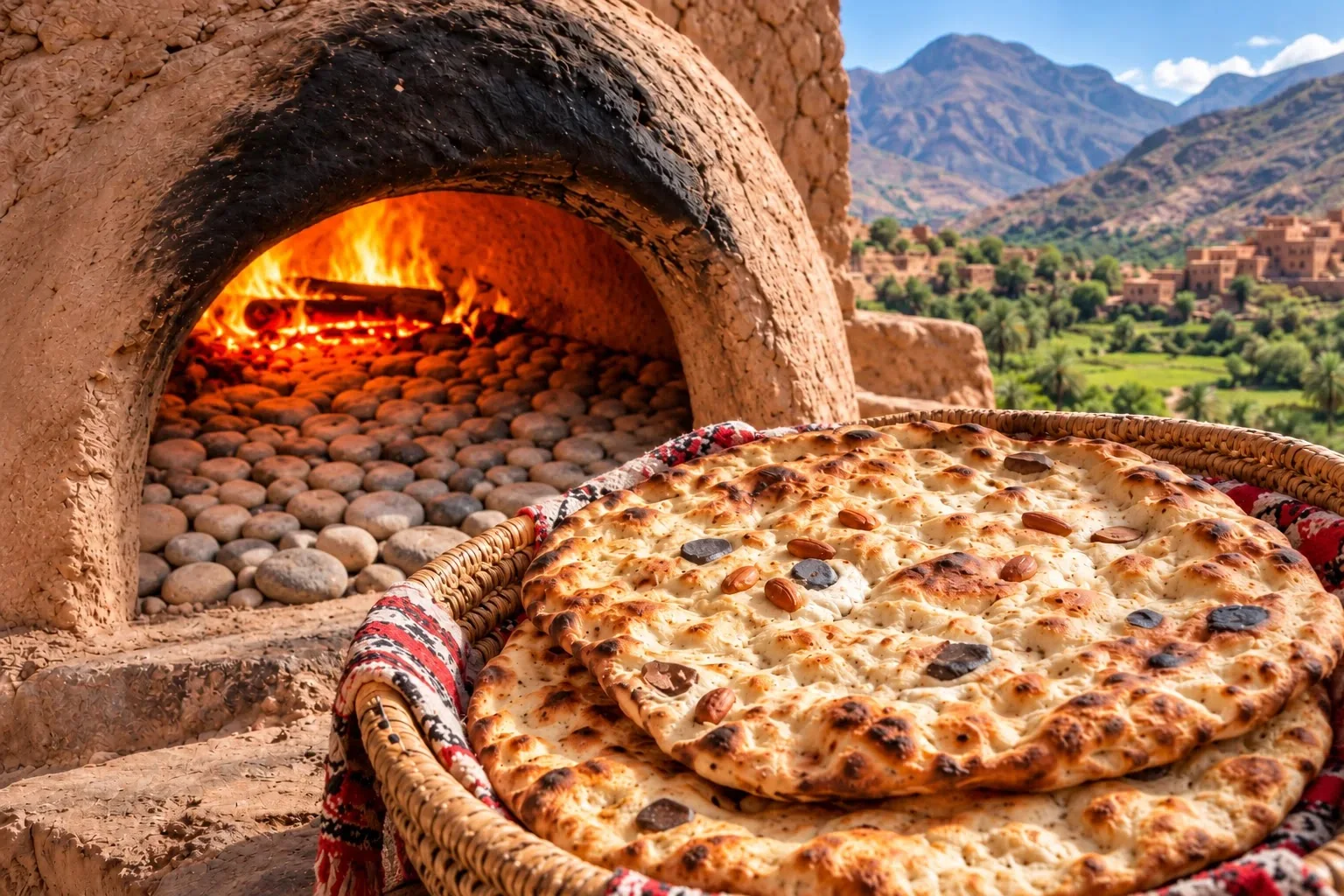
In the mountain villages of Souss, one of the most distinctive Moroccan breads comes from an oven that looks quite different from the one most of us use at home. Inside a traditional clay structure, small rounded stones are heated by a wood fire before the baker lays the dough directly over them. When the bread comes out, its surface carries irregular marks left by those stones, and its crust has a texture that is difficult to reproduce on a smooth baking tray.
This is Tafarnout, also written Tafarnoute, a traditional Amazigh bread known across Morocco's Amazigh regions and particularly associated with Souss. Its name is connected to the clay oven in which it is prepared. Understanding Tafarnout means looking beyond the ingredients, because the oven itself plays an important role in giving the bread its appearance, texture and character.
The tradition is still part of life in the region, although the dough has changed in many households. Older preparations relied on whole wheat flour and handmade Khamira Beldia, the traditional Moroccan sourdough starter. Today, some families use combinations of different flours and baking powder while continuing to cook the bread in the same kind of traditional oven. Both preparations belong to the story of Tafarnout, but they should not be confused.
The Traditional Tafarnout Oven of Souss
The most recognizable feature of Tafarnout is its oven. In the mountain communities of Souss, the traditional oven is built from clay and prepared with a bed of small, smooth stones. These stones are traditionally collected near rivers, where flowing water has rounded their surfaces over time.
The fire is commonly made with locally available wood, including argan or olive wood. As the oven heats, the stones absorb the heat needed for baking. Once the oven is ready, the flattened dough is placed over the heated stones rather than onto a flat metal tray.
This is where Tafarnout develops its distinctive appearance. The hot, uneven surface leaves a pattern of small rounded impressions and browned spots across the bread. Because the dough rests against individual stones rather than a perfectly flat surface, the finished loaf has a more irregular shape and crust.
The result is not the uniform golden surface of an ordinary bakery loaf. Tafarnout has raised and sunken areas, darker patches where the heat has been stronger, and a pleasant contrast between its browned exterior and tender interior. Those marks are part of its identity, not imperfections that need correcting.
This way of cooking also explains why the traditional oven cannot be reduced to a decorative element of the recipe. The heat, stones and clay structure work together. The dough is relatively simple, but the environment in which it bakes gives Tafarnout much of its character.
How Tafarnout Was Traditionally Prepared
Before commercial leavening became common, Tafarnout was prepared with whole wheat flour and Khamira Beldia, the traditional natural starter maintained from one bread preparation to another. Families used the wheat available to them and allowed the dough to ferment before baking.
Khamira Beldia develops through natural fermentation and differs from commercial baker's yeast or baking powder. It contributes to the flavor of the dough and requires enough time to become active. The exact fermentation period depends on the starter and the conditions in which the bread is prepared.
This older preparation shares part of its heritage with other traditional Moroccan breads, including Khobz Zraa made with whole wheat flour and Khamira Beldia. The difference is especially noticeable during baking. Khobz Zraa is generally formed into round loaves for an oven, while traditional Tafarnout develops its distinctive surface against the heated stones of the clay oven.
Another detail from the older Tafarnout preparation is the addition of small pieces of almonds to the dough before baking. These were pressed into the bread rather than served separately afterward. It is an interesting reminder that traditional household recipes often carried small local touches that modern standardized recipes leave out.
The use of almonds also fits naturally into the food culture of Souss, where almonds, argan products, grains and locally prepared breads have long been familiar ingredients. They are part of the same regional food traditions in which the bread is prepared, baked and shared.
Over time, the ingredients used in Tafarnout have become more varied. Some households now combine whole wheat with white flour or fine semolina, known as fino. Baking powder, called levure chimique, is also used in modern preparations. These changes make the dough quicker to prepare, but they do not reproduce the long fermentation of Khamira Beldia.
Importantly, this change does not mean the traditional Tafarnout oven has disappeared. Women in Souss still prepare the bread using adapted dough recipes and bake it in the familiar clay ovens. The preparation has evolved while its distinctive method of baking continues.
How to Make Tafarnout Bread at Home
For a modern homemade version, I use a mixture of whole wheat flour and fine semolina. This version is based on the preparation now used in parts of Souss, with baking powder instead of the traditional sourdough starter. It is practical for a household kitchen while retaining the wheat flavor and thin, rounded shape associated with Tafarnout.
The ingredient list is short, and the dough does not require a long sourdough fermentation. The main challenge at home is reproducing the heat of the traditional oven. A conventional oven produces good bread, but it will not create exactly the same texture as dough baked directly over heated river stones.
Ingredients
- 250 g whole wheat flour
- 250 g fine semolina (fino)
- 1 teaspoon baking powder (levure chimique)
- 1 teaspoon salt
- Approximately 250 ml warm water, adjusted as needed
- A little extra fine semolina for shaping
I begin by combining the whole wheat flour and fino in a wide mixing bowl, then add the baking powder and salt. The dry ingredients are mixed thoroughly before I gradually pour in the warm water. I work the ingredients together by hand until they form a soft, cohesive dough. The amount of water may need slight adjustment depending on the flour and semolina, so I add it gradually rather than forcing the mixture to absorb an exact quantity.
Once the dough has come together, I knead it for about ten minutes until it becomes smooth and pliable. It should feel soft enough to flatten without tearing easily, but not so wet that it sticks heavily to the hands. I then cover it and leave it to rest for approximately thirty minutes. Because this version uses baking powder rather than sourdough starter, the purpose of the rest is mainly to relax and hydrate the dough. There is no need to wait for it to double in size.
After resting, I divide the dough into portions roughly the size of a fist. Each portion is rounded, then flattened on a surface lightly dusted with fine semolina. I aim for a fairly thin round, approximately half a centimeter thick, rather than the thicker shape of an ordinary Moroccan khobz loaf. I press the surface gently with my fingertips to create small indentations and discourage excessive puffing during baking.
For the home version, I preheat the oven to at least 220°C, using a baking stone or baking steel rated for the temperature if one is available. Allowing the baking surface to heat thoroughly, for approximately thirty minutes or according to its manufacturer's instructions, helps the bread cook quickly and develop browned areas. I do not recommend collecting ordinary river pebbles and heating them in a domestic oven. The stones used in traditional ovens are part of a specialized local baking practice, while unsuitable stones may crack or fracture when exposed to high heat.
Once the oven and baking surface are hot, I carefully transfer the flattened dough onto the baking stone or steel, or onto a preheated baking tray if that is what I have. The bread is baked until the surface develops golden-brown patches and the center is fully cooked. Cooking time depends on the oven and thickness of the dough, so I judge the bread by its appearance and texture rather than one fixed number of minutes. After removing it, I let it rest briefly under a clean cloth before serving while still warm.
This home adaptation produces a satisfying flatbread, although the surface will be smoother than traditional Tafarnout. The characteristic pebble impressions belong to the original clay-oven method. For me, understanding that difference is part of respecting the traditional preparation rather than pretending a modern oven produces exactly the same result.
Eating Tafarnout in the Mountains of Souss
In Souss, Tafarnout is not limited to a single meal. When freshly baked, it is particularly enjoyable with argan oil, traditional butter, honey or amlou, the familiar Moroccan preparation made with roasted almonds, argan oil and honey. A piece of warm bread with amlou and Moroccan mint tea makes a simple, satisfying breakfast.
The combination works because the bread has enough texture to hold the oil or amlou without disappearing beneath it. Its browned crust contrasts with the softness of the toppings, while the flavor of wheat complements the almonds and argan oil.
Tafarnout also accompanies savory meals. It is eaten with meat, vegetables and traditional Moroccan tagines, where pieces of bread are used to gather the food and sauce from the shared dish. Like other Moroccan breads, Tafarnout has a place in the way Moroccan food is traditionally shared, rather than being an accompaniment served without a purpose.
I experienced another side of this tradition during a recent visit to Imi N'Tizghte (إمي نتيزغت), a village in the Ameln commune of Tiznit Province, in the Souss-Massa region. There, I ate Tafarnout with roasted meat from a mountain-raised goat, a combination that gave me a different appreciation of the bread.
The goat meat was prepared without a complicated marinade or spice mixture. It went directly into a traditional oven to roast, allowing the flavor of the meat itself to remain at the center of the dish. After cooking, it was served with salt, cumin, black pepper and paprika.
What impressed me most was the taste. Although herbs had not been added as part of the preparation, the roasted meat had a distinctive herbal flavor that I found particularly enjoyable. The seasonings served alongside it were simple, and the warm Tafarnout made the meal even better.
This was not a special recipe invented by the guesthouse where I ate. It reflected a way of preparing meat and serving food found across the surrounding mountain communities. Traditional ovens are used for more than bread, and the combination of locally raised goat meat and freshly prepared Tafarnout belongs naturally to the region's food culture. Elsewhere in Morocco, mechoui made with lamb offers a different roasting tradition in which the flavor of the meat remains central.
That experience also reminded me why traditional food is difficult to understand through ingredient lists alone. The bread, the oven, the roasted meat and the way everything reaches the table are connected. Tafarnout is part of that wider relationship between the mountain environment, local ingredients and household cooking.
Why Tafarnout Remains Part of Amazigh Food Culture
What makes Tafarnout worth preserving is not the idea that every family must follow one unchanging recipe. The tradition has already adapted. Some households continue to use whole wheat flour and natural Khamira Beldia, while others prefer mixed flours and baking powder. Almond pieces once pressed into the dough are another detail of the older preparation that deserves to be remembered.
The traditional clay oven remains central to the bread's identity. Its heated stones leave marks that a flat baking tray cannot reproduce, and the wood-fired heat contributes to the character of the finished loaf. These details explain why Tafarnout is different from ordinary Moroccan khobz, even when the ingredients appear similar.
For anyone visiting Souss, I would recommend tasting Tafarnout where it is traditionally prepared. Eat it warm, whether with argan oil and amlou in the morning or alongside a substantial meal with tagine and Moroccan salads later in the day. The bread makes more sense when you experience its texture and the foods people serve with it.
My meal in Imi N'Tizghte reinforced that understanding. The Tafarnout and roasted mountain goat were memorable because the preparation respected the ingredients rather than hiding them under elaborate seasoning. The bread belonged at the table as naturally as the meat itself.
That is the Tafarnout tradition I want readers to know: a distinctive Amazigh bread shaped by the clay ovens of Souss, carried forward through changing household recipes, and still enjoyed as part of the meals that define everyday life in Morocco's mountain communities.

CONVERSATION